OpenTheo

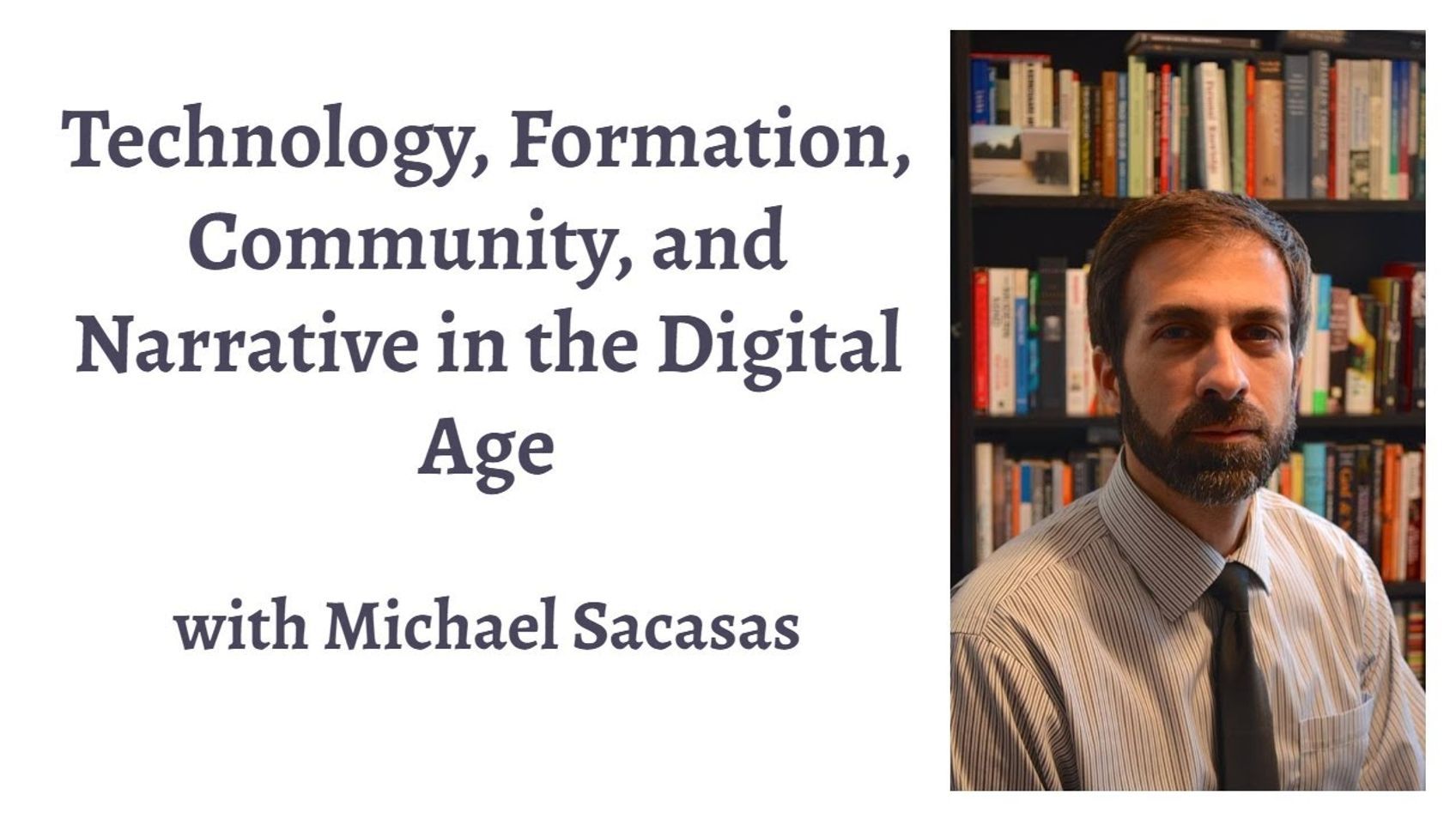
Technology, Formation, Community, and Narrative in the Digital Age (Michael Sacasas)

Alastair Roberts
00:00
00:00

Technology, Formation, Community, and Narrative in the Digital Age (Michael Sacasas)

July 3, 2020
Alastair Roberts
Alastair Roberts

Michael Sacasas, one of the most thoughtful contemporary commentators on technology and media, joins me for a wide-ranging conversation.

Read more of his work here:

'The Analog City and the Digital City': https://www.thenewatlantis.com/publications/the-analog-city-and-the-digital-city

Narrative Collapse: https://theconvivialsociety.substack.com/p/narrative-collapse

Sign up for The Convivial Society newsletter: https://theconvivialsociety.substack.com/

The Frailest Thing: https://thefrailestthing.com/the-frailest-thing/

Frailest Thing compilation book: https://gumroad.com/l/CWRfq

Recommended Books:

Neil Postman, 'Technopoly': https://amzn.to/3gt3u9J

Marshall McLuhan, 'Understanding Media': https://amzn.to/2NP2GQu

Walter Ong, 'Orality and Literacy': https://amzn.to/2NVxkaK

Albert Borgmann, 'Power Failure': https://amzn.to/38somuY

Ivan Illich, 'Tools for Conviviality': https://amzn.to/2Asqnel

Jacques Ellul, 'The Technological Society': https://amzn.to/31IYSZi

If you have enjoyed my output, please tell your friends. If you are interested in supporting my videos and podcasts and my research more generally, please consider supporting my work on Patreon (https://www.patreon.com/zugzwanged), using my PayPal account (https://bit.ly/2RLaUcB), or by buying books for my research on Amazon (https://www.amazon.co.uk/hz/wishlist/ls/36WVSWCK4X33O?ref_=wl_share).

The audio of all of my videos is available on my Soundcloud account: https://soundcloud.com/alastairadversaria. You can also listen to the audio of these episodes on iTunes: https://itunes.apple.com/gb/podcast/alastairs-adversaria/id1416351035?mt=2.

Share

Transcript

Hello, and welcome back. Today I'm joined by Michael Sacasas, who's the Associate Director of the Christian Studies Center in Gainesville, Florida, and the author of the Convivial Society newsletter. And he's one of the most thoughtful Christians on the subject of media and technology, and I wanted to have him on today to discuss particularly some recent work that he's been doing on narrative collapse and also the analog and digital city.
So thank you very much for coming on.
My pleasure, Alastair. Glad to be here.
First of all, what got you into thinking about technology and media? It seems to be an area that, where there isn't an awful lot of focused Christian thought, what particularly inspired you to look into the area, and what has given you a sense of urgency to your work? That's a good question, and one to which I'm happy to report I actually have a very precise answer. It was encountering a chapter in a book by Craig Gay, the sociologist. The book was titled The Way of the Modern World, and I think it was published in 1999 or thereabouts.
And it was assigned to me when I was doing my Master's of Theology at the Fulton Theological Seminary. And in there, there was a chapter on, the thesis of the book, it was examining how some of the structures of contemporary life make it difficult to live by the beliefs that we give intellectual and verbal ascent to. And so, Greg Gay had a chapter on science and technology.
And it was, I think, the first time that I had ever read about science and technology being discussed in this way as a formative influence on our moral and even spiritual lives. And that certainly caught my attention. I went on to then do some reading in some of the classical writers in the media ecology school, most notably Neil Postman.
And it became apparent to me, I was sort of convinced I became a true believer as it were that how we relate to our technologies, how we relate to the world, to each other through our technologies is a kind of a critical aspect of who we are, who we're becoming, how we realize our projects in this world or fail to realize them. And so it seemed to me that that was not given enough attention. And certainly I didn't think it was being given enough attention in contemporary Christian circles, or even in the wider public, which in the United States, at least for the most part, I think tends to be generally really enthusiastic about new technology and uncritically accepting, kind of an adopt first, ask questions later sort of attitude.
So that's, yeah, I think that's how that started and it kind of continued from there. I ended up in the beginning of PhD, I finished, I didn't finish the dissertation for a variety of reasons, but it was also kind of focused in this area, it was in a digital humanities program, which was a little bit different than where my own interests lay, more specifically sort of an ethics and philosophy of technology. But I was working with Hannah Arendt on her thinking about technology.
And so even after leaving that program,
I've continued to think and write about these questions. In my experience, most Christians, particularly evangelical or conservative Christians, are idealist in their approach to society. They think that society is very much the outworking of ideas, and yet your project seems to be a very materialist one in its focus.
How have you found
the reception for your work? What sort of inroads do you think you've found in people come to grips with the idea that our technologies might actually shape us? Yeah, and that's a very good point. I sometimes say that I'm interested in technology in part because I don't exactly buy into the idea that ideas are all that matter, right? That we just sort of have the right set of ideas, check off the right sort of worldview components in our head, then everything sort of plays out as it will. And so that focus on habits and our formation through our material environment is definitely part of what I especially want to bring to the table in talking and writing for Christian audiences.
And honestly, I would say that the reception tends to be pretty positive in the sense that I think it is illuminating. I think you begin to sort of give examples about how certain technologies mediate our perception or change the way we view the world or change how we relate to other people. And those examples I think are pretty common.
And once you point people's attention to them,
it's one of those things that they sort of see and then can't unsee. And I think it does readily become apparent that yeah, all that matters is not how we relate to our technology, but it's an important part of the picture. I sometimes describe it as sort of the unnoticed front in the battle for our souls, right? That puts it a little dramatically.
But we're often focused on other fronts, especially in certain, maybe even especially reformed circles, sort of the intellectual front where we fight the battle of ideas. But all the while, there is this other realm of our experience where we are being formed and shaped sometimes at counter purposes to what would be our explicit preferences with regards to behavior and character and virtue and the like. And one thing I've appreciated about your work is although some people have this idea of critics and people who are asking questions about technology as just instinctive Luddites, it seems to me that the people who criticize technology are often calling for deep literacy in the way that our technologies shape us.
And they understand technologies on a deeper way, a deeper level than
those who just instinctively accept them. And it seems to me that that is much of what your project is about, asking good questions and illuminating what it is that we are dealing with when we're dealing with the new technology. Yeah, and I'm glad that comes across, right? So, you know, what I find myself often sort of citing that portion of the abolition of man, where C.S. Lewis says that no matter what I say, people are going to take this to be an anti-science screed.
And that is sometimes the case. That, you know, if you just sort of raise questions about technology in certain circles that immediately raises a certain defensiveness about the tools that have become so much a part of our life world and our identity. But it's not about being anti-technology in my view.
What I try to stress to people when I write and talk is that
it's about wanting to realize what you hold as ideals in your own particular worldview. I mean, this can be true in Christian and even non-Christian circles. The sort of person you want to be, the kind of relations you want to have, the kind of world that you want to see, the kind of society that you want to envision.
How does technology impact the realization of those aspirations? Because it does. And so the point is not to simply resist technology. I've said for a long time that the instinctive anti-technologist and the instinctive technophile both have something in common.
They're not going to think. They're either going to instinctively reject or instinctively adopt. But the point is to think.
McLuhan has a wonderful line where he talks about understanding as a mode of resistance. Where resistance is necessary. And so, yeah, I think my project has often been to raise questions, to simply walk through what I sometimes just call the meaning of technology, right? How does this technology shape the meaning of our experience? If I may, I'll give an example that I sometimes use.
I became a father not that long ago. So about
my oldest is about to be five years old. And so I did what so many parents now do.
We go through these different visits and at some point
we see a sonogram of the child and we can elect to know what the gender of the child will be. And we did so. I had a little bit of an inkling to maybe be surprised, but my wife wanted to do some planning beforehand.
So we learned that we were having a girl.
And I think it's easy to forget, maybe especially for the younger among us, that this is a relatively new technology, right? I think it probably dates to the 1970s where we could determine with some measure of certainty the gender of the child in the womb. And so is this a good thing or a bad thing? I'm not entirely sure, but I know it changes the experience because I know my experience of being a father very much changed the moment that I knew that I didn't just have a nondescript child in the womb, but that I had a girl.
And from that point forward, the remaining months of that pregnancy on my end as father were definitely changed. The meaning of the experience of being a parent changed. And so I think it's useful to reflect on that, to think about that.
Even if we don't at the end of the day say, well, this is bad or this is obviously good, it just bears reflecting upon. And so that's one way of thinking about what I'm trying to do is just sort of explore the meaning of technology even before we arrive at judgments, which will always be conditioned on our prior moral values about whether this technology is good or bad. You think it's helpful to speak about our relationship to technology as such rather than just particular technologies? Because it seems to me that there is something about our relationship to technology as such that has changed in the modern world.
For instance, I think about things like the internet. They're far more totalizing as technologies than former, I mean, certainly tool-based societies. How do you see our relationship to technology as such changing? Do you think that's a helpful way of speaking? Yeah, I think so.
So on the one hand, I sometimes
Leo Marx, a venerable historian of technology and culture, wrote an essay several years ago on technology as a hazardous concept. And so in his view, this word that we use, technology, right, to designate everything from the laptops that we're using, the smartphone, the pencil, the satellite in space, the nuclear power plant, all of these things we call technology. And in that sense, to speak of technology can be kind of obfuscating.
Because what does it mean to be anti-technology anyway? If I'm critical, perhaps, of developments in bioengineering, that doesn't necessarily mean that I am against the value of a pencil or clean water, right? And so, yeah, I sometimes want to press in certain circumstances for a more specific analysis. So that we're not talking about technology writ large, but about this technology and its characteristics. On the other hand, having said that, I do think it can be useful to navigate to the other end of the spectrum, where we do try to sort of understand or identify what might be characteristics of a wider technological order in any given period.
So I think, for example, of Albert Bortman's attempt to do this. Albert Bortman, who I think is one of our preeminent Christian thinkers about technology, a Catholic philosopher, he tried to, this was in the 1980s, to sort of arrive at what he felt was a general pattern that characterized much of modern technology. He ended up with what he called the device paradigm.
And I think that there is some value in that, too, and especially to recognizing that when we move from, for example, Neil Postman in Technopoly talks about these three stages. Tool-using culture, and then what he calls technocracies, and then technopolies. And in each case, technology colonizes, in his view, more of the culture, more of the society, more aspects of life.
And individuals lose a little bit of control and then more control in each of these successive iterations of the kind of techno-social configuration. And so I think there's a way of talking about digital technology as a whole that I tried to do while still recognizing that there are a lot of variations within this whole that we might think of as digital technology that would encompass the ring camera on the doorstep, the smartphone, the computer, the digitization of media that allows for the transmission of video in this sort of almost immediate way across an ocean, right? So that's a great variety of different aspects of this one thing, though, digital technology, which may have, and I think does have, some certain characteristics that are worthy of analysis on the whole. So I think it's good to telescope, I guess, back and forth between the, you know, larger scale analysis and the more fine-grained analysis and to allow each to inform the other.
I found a little helpful on the idea of technique, for instance, or even Heidegger, some of his stuff on technology can be helpful for thinking about the whole. I'd be interested to get into the subject of your recent article on the digital and the analog city. It seems to me that you explore within that part of the evolution of a particular technology.
So the internet that we had 20 years ago is not the same thing as the internet that we have today. Can you explain something about the thesis of the piece and also what sort of evolution you have witnessed within the technology? Yeah. So the idea for the piece, and part of it stems from the fact that I do kind of buy into this media ecological perspective where the invention of these major technologies of human communication, writing, and then later print and then electronic forms of media like radio and television and the telegraph, and then more recently digital means of communication, that each of these do amount to kind of watershed moments that have really wide-ranging and radical consequences for both human consciousness, how we think about ourselves, what we think with how we think, and then also for the organization of human society.
And so that if that is the case,
if we think like Neil Postman says that Europe in 1500 was not the same Europe that, so when you add the printing press, Postman says, you don't get the old Europe plus the printing press. You get a new Europe. And so what does that mean for us thinking in that piece specifically about the American context? This advent of digital technology, the internet perhaps specifically, that is a radical reordering of how human beings communicate, the tools that mediate our consciousness and our relation to others.
What are the particularly political consequences of this? And that was sort of the occasion for this piece as a lecture on the political consequences of the internet. And that's what I wanted to think through. And I'll be the first to tell you that I don't believe I have anything like a definitive answer to those kinds of questions, but it was an attempt to kind of map a little bit of that terrain as it's still unfolding.
And I think that the
I would say that the main characteristic of the main change that happens, the main evolution that happens, is that when in 1995 or 94, I began logging on to AOL for the first time, I had to go somewhere to do that. And it was a very defined sort of experience. I had to make sure nobody else was on the line or that nobody would be calling and I would, you know, using a dial-up modem, and I would have to sit there and wait patiently for pictures to pixelate line by line on the screen.
And so really up until the mid-2000s or 2000-odds, to be online was to be somewhere, right? You had to go to the internet cafe, for instance, if you were traveling and wanted to use the internet. Whereas the introduction of mobile technology and Wi-Fi made the internet experience nearly ubiquitous, right? If I have an internet-connected device in a wireless account, a cellular account, I can get on the internet virtually anywhere in the world. And so it goes from being something that I do on occasion to then permeating the whole of my experience, being a mediating point.
The smartphone in many ways becomes a point of convergence of all these different technologies,
and it becomes a way through which I'm constantly mediating my experience of the world. So I think that's the main difference. Of course, it's a question of broadband technology, of the speed of the connection, but also I think of its ubiquity, of its ability to be with us everywhere, and for everything to be increasingly integrated into this digital web.
That I would say is the chief difference that we might perceive over those years. Perhaps one of the most helpful passages within that piece for me was your description of how the internet and the dense context of social media changes the way that I suppose the most basic human tool of all, the word, operates. And how the word ceases to be an inert thing as it has been very much within the age of print and moves back to something more characteristic of the age of orality.
Yeah, and there I'm unabashedly leaning on the work of Walter Ong and trying to sort of extend that work to make sense of our president. And Ong talked about the invention of writing and its consequences for human speech, and of course Plato does the same in the Phaedrus. And so there is this long sort of tradition of reflecting on this, but Ong did a wonderful job of crystallizing some of these concepts.
And one of the things that he points out is that when you put the word when we think of the word, right, before writing one, the word was evanescent, he says, you know, it's an utterance. It's not something you can see, right? Literate individuals, if asked to think of a word, almost find it impossible to not think of the symbols representing that word, right? So if I say think of the word cat, we think of cat, the symbols that represent that. The word becomes itself a thing rather than simply being an action in the world.
One way that I think we might get at this is sort of the
the way in which modern readers are sometimes baffled, or puzzled at least, by the fact that Isaac simply can't take back his blessing, right? That it's not just something that can be erased because in the oral mind it is an action that is already committed. It cannot be undone, right? It's not simply a word that can be erased. That's become inert and powerless to effect change in the world.
Now, I think this is why in part in the early modern period and in
an early modern political theory, theorizing about speech, about freedom of speech, you can grant speech a great deal of latitude in part because it has been tamed as it were by the inertness of the text and the way that writing separated the act of thinking and writing and then the delivery of that content to another, right? So how long does it take to write a book, to get it published, to then making its way, or a pamphlet even, right? It's making its way to the reader who is nowhere near the vicinity of the author. But what happens with digital technology is that the work is in a sense reanimated. I think it's how I put it in that article.
It becomes alive in a new way. It's still print.
Excuse me, I should say it's still textual, right? So when we read a tweet, very often we're still reading words, but we're reading words with a kind of immediacy that was foreign to the world of print media, right? I type it and I'm not sure how many people immediately are seeing it, but I know there are any number of people who immediately will see it who might immediately respond back to me.
And so that immediacy, I think, reanimates the work. And it makes things happen in the world, right? And then it gives us sort of an immediate sort of emotional charge or experience. It becomes alive in new ways.
And so I think for that reason it can seem less tame.
And that to me at least goes some part of the way towards explaining why, at least in the American context, freedom of speech is now something that is up for debate, as it were, right? The values of free speech, as it were, now are not simply taken for granted, but are something that require kind of moral adjudication. And I think in part it's because the quality of the word has changed in this way because of the technology that we use to communicate.
It seems to me that certain philosophical approaches to the word gain a greater salience as a result of this new media technology. I mean, think of Wittgenstein's approach to understanding meaning or J.L. Austin on speech act. And then just the idea of speech as power, that if speech is something that is primarily an action, then people are a lot more alert to what is being done.
What is the intent of this action?
Who is acting? What is the end in view? And often that can obscure any sense of the actual meaning of the words in and of themselves. And I think it comes also with the, maybe you could talk about the undeath of the author online, that there is an immediacy of the author's presence, that you can't detach their words from them. And so their words are still connected to them, and they obviously have some purpose.
And that sort of occult divination of what's actually going on in their mind becomes a lot more urgent a task. Yes, I think that's a very good observation. That's right.
So along with this piece, you've also written recently on the subject of narrative, which it seems maybe a bit of a diversion from the subject of technology, but you suggest that it can be helpfully thought about as a technology. Can you explain why you think narrative can be understood in that way, and how it actually helps us to understand narrative better? Yeah, so I, Katherine Hales, a media scholar, Duke University for a long time, I'm not sure if she's still there now or not, but I remember reading an article by her about 10 years ago in which she talks about narrative, and she described narrative as a meaning-making technology. And that kind of stuck with me, and she went on to describe human beings as essentially narrative-making, meaning-seeking animals, right? That we seek meaning, and then the primary tool by which we extract meaning from the world is the deployment of narrative.
I mentioned technique earlier. So sometimes when I talk about technology, and try to define even the term, I encourage people to think about technology first, of course, as tools you can hold in hand or point to that have a material reality, but then that we might also think of a more abstract form of a tool, right, a mental tool, in which case we might even think of something, as I suggested in that essay on narrative, the algorithm. The algorithm is a sequence of steps, as it were, right? It can be purely conceptualized without having any kind of material reality.
And so we think of that as a technology, and in the same way, I think it's useful to think of narrative as a tool that we deploy, as a tool that we use as means toward an end. And that end is not exclusively, but in large measure, I think the end of making sense of the world, right? If we encounter any disparate set of events, and we want to sort of understand their relationship, ordinarily, I think what the human mind tends to do is to try to make a story out of it, right? To tell a story that accounts for the temporal sequence of events, but also the causal sequence of events. And so we deploy narrative as a way of making sense of our experience.
And in that way, it is a kind of tool, although, of course, it's a tool that's so close to us, so deeply internalized, that we hardly think of it as a technique or as a tool. It seems to me that we use the word narrative in that sort of sense a lot more nowadays, when people talk about the media narrative. It's often used in the sense of criticism or suspicion of the media.
But it seems fairly commonplace now, in a way that maybe it wasn't before, that people have a sense that in this rather chaotic information deluge society, you need something to kind of corral all these realities together into something that has some coherence. And the narrative, which is often employed, as I said, suspiciously, is the means by which people do that. Yeah, and so I think there are two interesting things there in what you just mentioned.
One, on the one hand, is a kind of self-consciousness about what we're doing. That we are, in fact, telling stories and sort of become aware of ourselves as storytellers. Which is not to say that, of course, we've always sort of imagined, we've always had a category for the storyteller.
The bar, the writer of stories. And so it's not that this is new, that we see some individuals as those who tell stories. And maybe some have even fashioned themselves as a good storyteller, right? Someone who can spin a big yarn or whatever.
Archaic phrase we might use for that. But I think that there is a renewed sense of the, or a heightened sense now, as you say, for example, in the media, that the media is consciously sort of spinning a narrative. And it is often pejorative.
And I think that realization that what we are doing is creating a narrative. And that there is not simply a default narrative, right? Or that there can be an objective narrative that accounts for all the facts in a disinterested way, right? But that we are all sort of engaged in this work of taking facts and making them fit some preconceived view of the world, right? This is where the pejorative spin comes from. That all we are doing is sort of spinning the facts to agree with or support our own perspective.
I think we have become
increasingly aware that this is happening in the media. But then again, it's not, and I think that predates in some respects the advent of digital media. I'm not sure when Bill O'Reilly, for example, I think popularized the term the spin room, right? Or the no spin zone, I think is what he used to call his old network show.
And so it's not that that is even sort of unique to digital media.
But I think digital media then puts us all in the position, one, of being flooded by information. Right? So if I have a fairly diverse feed and I log on to Twitter, at any given moment, I can see some phenomena being discussed.
But being discussed from a multitude of perspectives, different details being highlighted, different facts being brought to my attention. And there's a kind of imperative for me, not simply to accept the narrative, because I can see that there are competing narratives, but to try to make sense of it my own and thus sort of try to weave my own my own story to account for what is happening here more or less successfully. And this is why I've written another place that the mode of conspiracy theorizing almost becomes the default existential feel of what it is we're doing, right? I think we all feel as if we've got all of these different facts that we try to account for and we do so by connecting the red thread on the wall and trying to make sense of it the best that we can.
But it does almost take on this feel of spinning an almost an incredible narrative to account for this reality. And with an awareness all the while that others are doing the same, and with some sense that there is no God's eye view on this, from which we can sort of say, no, this is the narrative that counts for it. And so we're left with a wide field of competing narratives to make sense of the world.
It seems to me that there's something about narrative that is very distinct as a category. It's not just explanation as such. Narrative, at least as I understand it, seems to serve the purpose of informing action.
Narrative actually gives you
some direction in which to act. It gives you a sense of agency, or the agencies that shape your world. And I think that's one of the reasons why conspiracy theory is so attractive, because conspiracy theory has someone or something in the villain slot.
If you don't have a villain slot, it's very hard to have a compelling narrative. And conspiracy theories are, if nothing else, compelling narratives. So there are ways you could explain many of the situations that we find ourselves in, which don't involve narrative as such.
They could involve a lot of diverse explanations told from different perspectives, but they'll be narratively weak. But for a strong narrative, you need to have something in the villain slot. You need to have a clear sense of agencies.
And it seems also to me that one of the things that drives narratives today is the concern for a shared narrative. And that almost demands the push from more local occurrences into archetypal categories. So we see ourselves as playing out archetypal conflicts in these specific contexts that we find ourselves in.
But all the time there is this
overarching narrative into which everything gets agglomerated and gathered. Right. And I think that concern for a sort of unifying narrative or more public narrative, I think that's what I tend to see as almost being impossible to achieve at some level.
So in the piece I
oppose narrative to database and I'm following a debate in digital humanities back again nearly 10 years ago. I don't know its status at the moment, but between the different characteristics of narrative on the one hand and database on the other. And so my premise in writing this is that when you get online, it's not like reading an article in a magazine where the dots are in a sense connected for you, right? You have a story laid out for you about what has happened or even the way that we might speak about a story in a newspaper.
We call them stories.
So when we get online, we're confronted with not a literal database. It's not like we just see a table of different labeled entries, but we do see a field of data points that confront us.
And the question is whether or not there's a path laid out through that data for us. That's what narrative does, right? Narrative is selective. It says this detail doesn't matter.
This one does. And so we choose this way through
the field of the database. So Lev Manovich, another media scholar, in making this opposition between narrative and database, said that the database foregrounds the whole field of possibilities whereas the narrative foregrounds one path through that field.
So when we're online, the whole field is available to us.
You know, one experience of this, even in my own case, was early in mid-January, before at least in the United States COVID-19 would garner the attention that it would later on, seeing these little data points that would just kind of pop up in my feed of things happening in China, right? And some of it seemed almost very difficult to believe, honestly, right? You know, there were images and talk about bodies being stacked up outside of morgues and people being walked into. And all these were data points that called for a story because no story had yet been sort of assigned or written for it, right? And so you found yourself in that position of confronting a database and having to make your way through it and to order those entries into something meaningful.
And I think that's the experience of being online.
So any big N, capital N, as I say there, narrative, I don't know that it compels assent because, or can compel assent, because ultimately the database now frames the narrative. We come to the database and the narrative seems like an afterthought, something imposed, often very artificially, and often we judge in bad faith on the part of others, especially our political or cultural opponents.
One thing I've wondered about is just seeing the conflict between the database and the narrative that you describe, that when some of those points start to come nearer to hand, the way that the narrative tries to assert itself against the chaos, and so very often partisan narratives that try and frame a natural event that may not fit in, they may actually swamp the narrative as we tend to articulate it. There's no straightforward villain here. It's not the liberal elite's fault.
It's not the fault of
the patriarchy. There's something that's happening in nature and we just have to deal with it in, maybe create some new narrative or, at least it doesn't have the compelling force that the idea we're opposing this particular camp of people and they're the enemy, it doesn't fit to quite the same degree. And along with that, I've wondered at the way that we tend to rely a lot upon these big floppy categories.
So things like the liberal elite that
capture a lot of different things under them or the patriarchy, that all these different experiences of frustration or obstacles in our lives can get gathered together into this great overarching signifier that can be shared with many people. And that is one way that we can try and forge a shared narrative. But in the past, our narratives will be a lot nearer to hand.
They'll be about our neighborhood, presumably.
There's a passage in, I'm trying to remember where it is, I think it's in Amusing Ourselves to Death, where Postman talks about the way that when you've got this telegraph line between two cities, they're going to have to find something to talk about. And that common ground, I mean, what are they going to talk about? Maybe was it Princess Alexandra's hooping cough? I mean, something has to fill that space because humans want connection with other people.
And it seems to me that we've created a realm that is a vacuum calling for narratives, and there may not be any narratives that tidally fit. Right. Yeah.
And I should make clear too that I guess there are different ways of responding to this. I mean, clearly there are those
that will, in fact, buy the narrative. Often the narrative of their political and cultural or theological camp, whatever the case may be.
And so often this is part of, I think, one of the consequences of digital media is that it does have this tendency to reemphasize the importance of the group that you belong to. And maybe there in some cases can be something useful and helpful about that, you know, to find your people online, as sometimes put. But on the other hand, it can clearly have really, maybe even disastrous consequences for the larger body politic.
But we do seek these narratives and sometimes we buy into them. Others understand that it is a story and understand that what they are doing is not really, they may question the story or the details or may even be indifferent to the truthfulness of it. But it is their camp's story and they will double down on it.
And then the other position, of course, is to just
recognize this multiplicity of narratives, the self-interested nature of our storytelling, and become apathetic towards the possibility that there can be any sort of shared truth or shared communal understanding of a reality. But, you know, the COVID-19 again is interesting in this respect because at some point, when it first began to really affect the United States, I had recently been writing about the ills and discontents of hyper-reality, or of living in this hyper-mediated realm, disconnected from a more tangible experience of reality. And the appearance of the virus seemed to me to perhaps afford the possibility for sort of an encounter, a unifying encounter maybe even, with a reality that could not simply be integrated into our existing culture war narratives and camps.
And apparently at this moment, at least, it seems like that was a bit naive on my part because it is stunning the degree to which this fact out there in the world has at least at present been swallowed up into these very same narrative skirmishes, and hasn't transcended the differences, but in some respects just exacerbated them. What are some ways that you've found it possible to resist some of the damaging tendencies and habits that you've identified? In general, with respect to the narrative. That's a good question.
I don't know how well I do resist these tendencies.
I continue to think that narrative is a crucial tool for human beings. I don't know how we can properly be human without recourse to story.
And as you say, even the relation between story and action, I think I quote Alistair MacIntyre in that piece and his line about how I don't know what to do unless I know what story I'm a part of. And so I think on the one hand, it calls for a sort of renewed, it calls for humility, first of all, right? A kind of epistemic humility, an acknowledgement that there, humility coupled with patience, I guess I would say, that we can't expect to know everything immediately, that there may be facts that lie outside of our preferred narratives. And so that we have to have sort of the courage to confront the possibility that we are mistaken or that we are wrong or there are narratives we need to adapt.
A refusal to acknowledge that I think probably leads us down the worst paths that might emerge from this dynamic. And so humility, epistemic humility, patience for the unfolding of facts, for the unfolding of I'm thinking here specifically in sort of political controversies or in political debate, or even in managing something like the outbreak of the novel virus and how we ought to respond to it. And of course, I would say that there are, there is still the need for an overarching narrative of some form, right? And obviously speaking in a Christian context, the narratives applied to us by redemptive history, by the biblical tradition, I think we accept on faith as the story that is being told about the world in which we find ourselves.
And so recourse to that,
to that story obviously orders, at least for me personally, how I attempt to sort of ground my identity or make sense of my place in the world. And so within that story, I acknowledge my own limitations of my own knowledge, right? That I am not God in the world, but a creature in the world. And that as a creature, I have limitations on what I can know, what I ought to know.
And so that then also begins to inform how I attempt to process and make sense of the information that I encounter but even perhaps more importantly, the relationships involved in this processing of information, right? Whether they are political or communal or with my neighbors, with my brothers and sisters in the church, etc. And so those are some of the things that come immediately to mind. But I do, I should say also, you know, I feel sort of the the exhaustion, honestly, in some cases of being confronted with this unrelenting flood of information and needing to say, I don't need to know any more about this, right? Or, you know, I sometimes joke about how, you know, constantly on Twitter I have to make a decision about whether or not to find out about this thing that people are talking about and expend the energy involved in that.
And to sort of recognize that those are limits that
are good limits to acknowledge, right? That I can't know it all and I shouldn't want to. And knowing where to sort of say, this is enough right now. I need to make time for solitude, for a deeper engagement with one specific area of knowledge or for conversation, meaningful conversation with someone in the fleshes of work.
And so you have these counter practices
that I think help alleviate some of the overwhelmed and exhausted nature of our engagement with digital technology. Now it seems to me you mentioned the Christian narrative and I find within the Christian narrative a great source of resistance to techno-utopian narratives because technology doesn't really play that much of a role within the Christian narrative. It's certainly not front and center.
And so the
apotheosis of science and technology is not our eschatology. We have something great that we're looking forward to. And so whatever place science and technology has in the picture, it has to fit into that picture rather than setting its own.
And along with that the practices of the church are very technology light in their essence. Things like baptism, the Lord's Supper, hearing the word and being together in community. Now all of that gets increasingly framed by audio-visual technologies in certain churches, the car, things like that.
But at the very heart there is something that gives us some
purchase from which we can exercise a degree of resistance or at least get some degree of distance. Yes, and that, you know, leads me to also reflect on the fact that several of the philosophers and scholars that I've mentioned have a distinctly religious background, which is not often explicit in their work, but nonetheless informs their work. So McClough and Walter Ong, Albert Borgman, were all Roman Catholic.
And even Neil Postman, who was a Jewish in background and I don't believe practicing in the phase of Judaism, an active participant in the religious aspects of his Jewish identity, nonetheless did indicate that it was sort of a reading of the First, or excuse me, the Second Commandment that sort of triggered his thoughts about the medium and technology as a moral and informative force in human affairs. And that very simple principle that technology cannot for us be salvific, right? That it cannot be, that it, one of the ways in which it is framed in the biblical tradition where the things that we make are framed as idols, that it can become idolatrous. I think that certainly is a kind of inoculation towards some of the techno-utopianism that has been more rampant in at least Western society.
Even reading the biblical narrative, there seems to be points where that technological move is quite apparent in the story of the Tower of Babel. The technology is invented first and then immediately after that they come up with this idolatrous project. But it seems to be spurred by this new sense of power and the potential and that power to fire bricks then leads to all these other things.
And in the same way our new technologies can
fuel and empower our idolatrous imaginations. Right. Yeah.
One thing I've found increasingly difficult online is when we're using a technology, it seems that we need to have some degree of distance from it if we're going to use it. Some degree to which we are differentiated from it. We can center ourselves within ourselves and then understand the technology, the potentials, the ways it could be used, to what ends, the dangers, etc.
But online technology is increasingly a site where it's a self-representation. We're forging our identities here in a realm of mutual display. It's a realm of belonging.
It is the community. It is the conversation.
And so establishing that sort of distance that would enable us to use it in an effective and thoughtful way is very difficult.
How do you see what are some of the ways in which you have found or practices that you have seen that help people to establish that sort of distance? Yeah, that's a very good observation. The way in which digital technology sort of involves us and engages us and becomes a crucible of identity, I think, lends some of its, a good deal of its formative power and its hold on our lives. When the community is online and when it is so important, of course, for us as human beings to sort of appear before others, to be noted, to be seen, to be attended to, and when this happens online and when you appear online only by speaking or only by symbolic acts, then there's an increasing pressure to do so and to become increasingly involved in that particular web of relations.
So the simple answer that I used to give to your question, I could point to one thing that I would do, and that is I didn't own a smartphone. And that allowed me to at least have, you know, spaces in the day where I could not be connected. Now, I still don't have a smartphone.
I still keep a flip phone, but
having had to upgrade the flip phone, I now find that flip phones are connected, are internet connected, in pretty accessible ways. And so, you know, not surprisingly now, that's become a challenge, a new battle for me to fight, right? To sit at a traffic light and to immediately feel that temptation to just check for something. I don't even know what, right? But that constant need for that stimulus that comes through, stimuli that comes through the digital device, is very much now a part of my life in a way that it hadn't been before.
But
that was a kind of active measure that I took. And I always say in saying this, I recognize that it wasn't, in effect, a kind of privilege for me to do so. There are many people who find that it's a requirement of their job to remain connected.
They are given a smartphone as part of their duties, and so they don't have that luxury. So I want to be clear in saying that, that that there is a sense in which now being disconnected becomes a privilege. One that in some cases people are willing to pay for, to go on these very elaborate disconnection retreats where they're paying thousands and thousands of dollars just to not be connected.
And so I would say just finding spaces to do that, being extremely intentional about that, it would be, I think, very useful, and especially in in religious contexts, in Judeo-Christian contexts, to think of the Sabbath as a day in which we rest from those tools, which are for many of us tools of our labor. So that we, you know, we set aside looking for the same way that we, you know, might have been encouraged to set aside the ox in another age. And so that at least becomes a day of rest where we can refocus our our energies, our desires, have an ability to be sort of disconnected from that realm of appearance that that otherwise dominates our day.
To be very selective about our social media experience, because I think social media is a unique sort of subset of the online experience. You know, I can obviously be online in countless ways and never have a social media presence. But social media sort of uniquely, I think, cultivates some of these disorders.
So I don't have Facebook. I've managed to you know, make that break. And it was, you know, challenging for the same reason that many would indicate, that I was only connected to certain people through Facebook.
And so to be off of Facebook is to sort of lose those
connections, or at least make them much more difficult. But that's certainly something that I would encourage individuals to consider. And honestly, just taking a step back, I compromise with Twitter in part because it's been useful to me professionally.
And so I call it a devil's bargain, and I'm well aware that I'm making a devil's bargain. And sometimes I, you know, when I become self-conscious of the ways in which Twitter is working on me, right, I can feel it. And it's affecting, forgive me, the phone is ringing here.
Let me hang it up so it won't ring again.
To be sort of attuned to how these tools are working on you, and to recognize when it would be important to step away from them. I think that becomes just a vital discipline.
Yeah. Perhaps one of the areas where this idea of technology forming us becomes most acute in people's thinking is thinking about generational effects. So the effect upon digital natives.
What is democracy going to look like in the hand of digital natives? And more keenly, how are we going to train our own kids? So that sort of technology criticism has often come with that particular concern at the heart of it. Was it the disappearance of childhood that Neil Postman wrote, talking about the effects of television and image-based technology upon the space of childhood that enabled childhood to flourish as a reality? And the loss of that is a tragic one. And I think often people, even in something I've noticed, even in our modern novels for children, they often hark back to this period before the 1950s as this ideal period of childhood where people weren't raising their kids on TV.
They had larger families,
kids were in closer contact with nature, that sort of thing. And people are often very concerned about the effect of technology upon particularly online technology upon their kids, wanting to protect them from things that would harm them, wanting to encourage them to be formed in helpful ways, but also recognizing the immense power of the tool or the various tools that it offers us. And so what are some areas of advice and caution or models that you would give to parents wanting to raise their kids well in a media-saturated society where they may not have the sort of training in media that just enveloped them? Right, that's such a great question.
And one I obviously have thought about, I mentioned earlier, I have
a five-year-old and a three-year-old, and so that is a critical question. So I want to frame it because I think very often this gets presented as just a matter of sort of banning smartphones or managing screen time or instituting strictures, limiting, saying no to this, no to the other thing. And as any parent knows, it can become extremely exhausting and often even counterproductive in the long run.
And so I think the important thing is to first ask
who do I want my child to become, right? What do I want my child to value? What virtues do I want to cultivate in my child? Because then you're beginning from the good rather than from the bad that you're trying to avoid, but rather the good you want to attain. And I think this is true not just of children, but even of adults as we think about our own technology. It's never just about being for or against this technology or the other.
You know, in my view it is about who we aspire to become and how certain technologies interact with that aspiration, either by undermining or sustaining it. And so I don't oppose this or that technology for its own properties, so to speak, but for how those properties interact with the larger moral project that I want to see unfolding in my own experience. And so likewise with my children.
For one thing, I think in the earliest stages of childhood, I think it is extremely difficult to resist the temptation sometimes to simply allow a tool to babysit for us, right? And I feel that pressure, you know, working from home quite a bit recently, I understand that. And I want to always be very careful not to come across as being judgmental of the choices that parents make, right? So there's an immense temptation. It was true of the television, of the video cassette player, and increasingly of the smartphone, right? To simply set up our child with a device that will entertain them and thus kind of babysit them for a while.
And as challenging as that is to resist,
I think it is pretty vital that we make our best efforts to do so. Because I think it's still an unknown to us as to what kind of consequences that will have cognitively in the long run. I think we forget just how recent this experiment is that we're sort of running on ourselves with digital media, especially with the youngest of children.
And to be very cautious, especially at that age. And you mentioned, you know, the closer contact with nature. And I do think that is vital.
There is a... So if we back up and we sort of take for granted that there is a moral order, and that this moral order in some ways involves not just the ethical choices that we make, but how we relate to place and how we relate to time. But there are better and worse ways of ordering our relationship to these fundamental dimensions of our embodied condition as creatures. Then what we want to do is we want to achieve well-ordered relationships to place and to time.
Along with a capacity to make good virtuous choices and decisions. And so the rhythms of the natural world, right? The rhythms of rising in the setting of the sun, of the passing of the seasons, however they manifest themselves in time. I don't want to sort of wax overly romantic here or poetic, but I think that there is something about recognizing that we are creatures made to inhabit a particular ordering of the world and that we resist that to our own detriment, physical, mental, spiritual, and moral.
And so, you know, the degree to which we can in fact
connect to these natural rhythms. Natural rhythms, of course, have always been culturally inflected. Nonetheless, rhythms that are, I think for the most part, good for us.
Scales that are good for us.
That is what I think we ought to aim for. And then to step back and to ask, does this tool get me closer to that ideal or farther away from it? And then to, as early as possible, to begin, you know, conversation with children about this, to involve them in this kind of moral thinking about the choices that we make, the tools that we allow into our lives and those that we don't.
And of course, at some very early age, you simply as a parent have to make these choices for your child, but then to allow the child to own these, but not as a matter of saying no, but of embracing something good and true and beautiful. And then choosing to maybe reject one tool or limit the presence of another tool for the sake of these good things that I desire and that I have cultivated a desire for my children. At least that's the strategy.
I would say that's the way I would want to think about these things.
And then of course the countless individual choices that each family, each parent has to make. They're going to have to think through along these terms, in terms of what they're able to do, what a single mother can do, obviously is going to be very different than what a mother and father together with maybe even a grandmother living in the home might be able to do.
So the circumstances, of course, to some degree dictate what choices we can make, even with regards to our ideal. Does that make sense? It does. Yeah.
I've recently read Tara Isabella Burton's new book, Strange Rights, which talks in large measure about the effect of the internet and people who have been brought up on the internet, whose central gravity of their identity and belonging is on the internet, and the strange forms of religion that emerge from that. And your work talks about, I mean, the title of your newsletter is the convivial society. I'd be interested to hear more about your idea of society, the larger scale response to these things.
How can we form communities that give us a very clear and strong central gravity in reality itself and help us to engage with online media in the most appropriate and fulfilling ways? It's a great question. As far as the widest scope and scale of these sorts of questions, questions that may involve legislation from the federal government here in the United States, for instance, or the regulation to limit the scope and scale of big media corporations, that's outside of my realm of expertise. But there is a scale below that.
And I think this is part of our problem generally, that in modern society,
we have the individual on the one hand, the state on the other, and we've erased what sometimes get called these mediating institutions, these sort of middle-scale, smaller-scale institutions that can be a really enriching source of communal life. And so in speaking, you know, primarily to Christians, you know, I would say that the local church ought to be really a center of reflection and practice along these lines. Now, granted, even within a local church, you're going to have widely diverse opinions about these matters.
And so there's
there's a lot of leadership and training that would be involved to make this not just a matter of impositions, right, or to guard against a kind of factionalism arising within a local body in a way that sometimes may have arisen regarding the issue of homeschooling and public schooling here in the United States, a really poisonous divide. But if it can be approached in a wiser, you know, more virtuous manner, if, because you do require communal support in this, right, it's one thing for me to say, for instance, that I don't want my child, because of the reasons I outlined earlier, to own a smartphone until a certain age when she, I think, may be more mature enough to handle the responsibility that comes with that. But if every other child that she interacts with has a smartphone or access to digital devices, then that, you know, that becomes a more challenging venture for me, right? So to find a small community of families, maybe centered within the local church, that aspire to these more humane rhythms of life, that aspire to mutually support their desire to, you know, the shared desire to engage with the world more readily, to resist sort of the lure of constant perpetual digitally mediated experience, I think that that can be extremely valuable, because it would be very lonely, you know, fair to go at it, you know, individually, or even as one single family within a larger community that doesn't aspire to these same goals.
So the communal manifestation at that level of a local community, I think, can be, you know, is critical. But I think it also requires a lot of work at this point. You know, I think that there is, at least in the States, there seems to be sort of this instinctive worry about children and smartphones, say, and, you know, a lot of talk sometimes about smartphones and depression in teenagers, etc.
So I think there's a nexus of concern there
that can maybe be the beginning of a fruitful conversation about how we can, as a community, help each other navigate these digital waters more humanely, more wisely, more faithfully, ultimately. You've been working in this area for quite some time now. I'd like to know what are the places that you would recommend someone looking in these issues for the first time or wanting to dig a bit deeper? What would be some of the books that you'd recommend and the sources? And then how can people follow your own project and the work that you've been doing? Sure.
Yeah, I mean, I, some of the names I've already mentioned, I come back to again and again and again.
At a really popular level, the Neil Postman's book, Technopoly, it has maybe, it was written in 1990, I think, or in the 90s. And and so, you know, some aspects of it now seem a little bit dated.
But nonetheless, it remains a really great entry into many of these questions. And so I, you know, I heartily recommend it. And it's very accessible.
Postman's a great writer.
You know, I'd recommend McLuhan, but, you know, McLuhan is challenging. And so, you know, if you want to take a go at it, certainly, you know, understanding media is sort of the the the sort of default text that people might turn to.
If you're in, you know, certain pastoral ministry, or if you're thinking about the place of the word in all of this and how media affects the word, the written word, the spoken word, then Watarang's orality and literacy can be a really valuable tool that again can also frame our thinking about even digital technology today. Albert Borgman's, he has actually a book of collected essays where he reflects in an exclusively theological manner on technology. It's called Power Failure.
Again, I think it dates from the early 2000s. But it's a slim volume. And I think it's certainly something to for a thoughtful Christian engagement with technology.
It's certainly something I would recommend.
And then I am an Yvonne Illich partisan and Illich's tool for conviviality I think is very challenging. Illich was not one for incremental measures and he really calls us to think very deeply about even some of the institutions that we take for granted, like the medical profession, modernized medicine, or even the school, modern education.
So his work can be very bracing and very challenging. But I think for that reason, even if you don't end up agreeing with everything, it's still really clarifying and useful. Tools for conviviality is a slim volume.
And it is from Illich's work that I take the title of my newsletter. Actually, I sort of gesture towards both tools for conviviality, but also Jacques Ellul's The Technological Society. And so Ellul is another whose work can seem daunting, but I think certainly repays our attention.
And these are classic figures in what I have dubbed
the tech critical canon, right? This canon of older writers, sometimes whose work is often now ignored and superseded in certain circles, but I think who, because of their distance from our present milieu, and their many of these writers in their own lived experience sat between the many of them were born in the 1800s, some of them were born in the 1800s, and their work carried over into the 20th century or lived through the radical transformations of the early 20th century. Because of that experience, because of their distance from our own milieu and our own accommodations with what was then a burgeoning sort of techno-social order, it was a really fantastic perspective on technology. And so these older writers, I think, remain really valuable.
And yeah, my newsletter, The Technological Society, you can look it up. I try to write it twice monthly and sort of carry on this running conversation about the meaning of technology in our lives. You also have a short booklet that you've produced as well, haven't you, based on your old blog? Yeah, so most of my writing used to be found on the Freilist Thing, which is a blog I started when I began my graduate program.
The title is from one of Pascal's pensées. And so I shuttered it at the end of last year to focus on the newsletter. And so I collected what I thought were the best posts over the course of 10 years of writing there into a little book just titled The Freilist Thing.
10 years of reflecting on the meaning of technology. And if you go to freilistthing.com, it's still up and you can find a link to that there. I sell it through Gumroad, one of the small choices to resist the Amazonification of all things.
And so that's available as well. Thank you for mentioning that. Thank you very much for coming on.
I'll leave the links for those
books and recommended resources in the show notes. Thank you very much for listening. God bless.
Yeah, God bless.

More on OpenTheo

How Do I Reconcile the Image of God as Judge with His Love, Grace, and Kindness?
#STRask
October 20, 2025
Questions about how to reconcile the image of God as a judge with his love, grace, and kindness, why our sins are considered to be sins against God, a
How Did a Fisherman Write the Book of Peter?
#STRask
September 18, 2025
Questions about how a fisherman could have written the book of Peter, why people say that not mentioning the destruction of the temple indicates an ea
Is “God the Father” a Sexist Term That Demeans Women?
#STRask
September 29, 2025
Questions about whether “God the Father” is a sexist term that demeans women in general and mothers in particular, how long Hell has been there, wheth
What Are the Top Three Apologist Pitfalls to Watch Out For?
#STRask
October 2, 2025
Question about the top three pitfalls to watch out for when you start using apologetics in conversations with others.   * What are the top three apol
If We Don’t Need to Learn to Hear God’s Voice, How Do You Explain These Verses?
#STRask
September 11, 2025
Questions about why, if we don’t need to learn to hear God’s voice, there’s a command to earnestly desire the gift of prophecy, why we would need to l
The Boys Are Back in Town with Justin Taylor and Collin Hansen
Life and Books and Everything
September 1, 2025
It’s been a long time since the last LBE episode—too long some (i.e., our mothers) might say. But after a summer hiatus, the three amigos are back in
What Are Some Good Ways to Start a Conversation About God with Family Members?
#STRask
October 30, 2025
Questions about how to start a conversation about God with non-Christian family members, how to keep from becoming emotional when discussing faith iss
Why Do We Say Someone Was Saved on a Particular Date If It Was Part of an Eternal Plan?
#STRask
November 24, 2025
Questions about why we say someone was saved on a particular date if it was part of an eternal plan, the Roman Catholic view of the gospel vs. the Bib
The Heidelberg Catechism with R. Scott Clark
Life and Books and Everything
November 3, 2025
You may not think you need 1,000 pages on the Heidelberg Catechism, but you do! R. Scott Clark, professor at Westminster Seminary California, has writ
When Is It Time to Walk Away from a Conversation?
#STRask
September 1, 2025
Questions about how to discern when it’s time to walk away from a conversation, and how to cope with people charging you with being prideful and legal
Is 1 Corinthians 12:3 a Black-and-White Tool for Discernment?
#STRask
October 27, 2025
Questions about whether the claim in 1 Corinthians that “no one can say ‘Jesus is Lord’ except in the Holy Spirit” is a black-and-white tool for disce
The Resurrection Standoff: Licona vs. Ehrman on the Unbelievable Podcast
Risen Jesus
October 22, 2025
This episode is taken from the Unbelievable podcast with Justin Brierly in 2011 when Dr. Bart Ehrman and Dr. Michael Licona address the question: Is t
Can You Provide Verifiable, Non-Religious Evidence That a Supernatural Jesus Existed?
#STRask
November 10, 2025
Question about providing verifiable, non-religious evidence that a supernatural Jesus existed.   * I am an atheist and militantly anti-god-belief. Ho
Is It a Sin to Feel Let Down by God?
#STRask
November 6, 2025
Questions about whether it’s a sin to feel let down by God and whether it would be easier to have a personal relationship with a rock than with a God
Do Christians Need to Believe that Jesus was Raised Bodily from the Dead? Licona vs. Patterson
Risen Jesus
October 15, 2025
In this episode, Dr. Stephen Patterson, New Testament professor at Eden Theological Seminary, argues against the bodily resurrection of Jesus, contend