OpenTheo

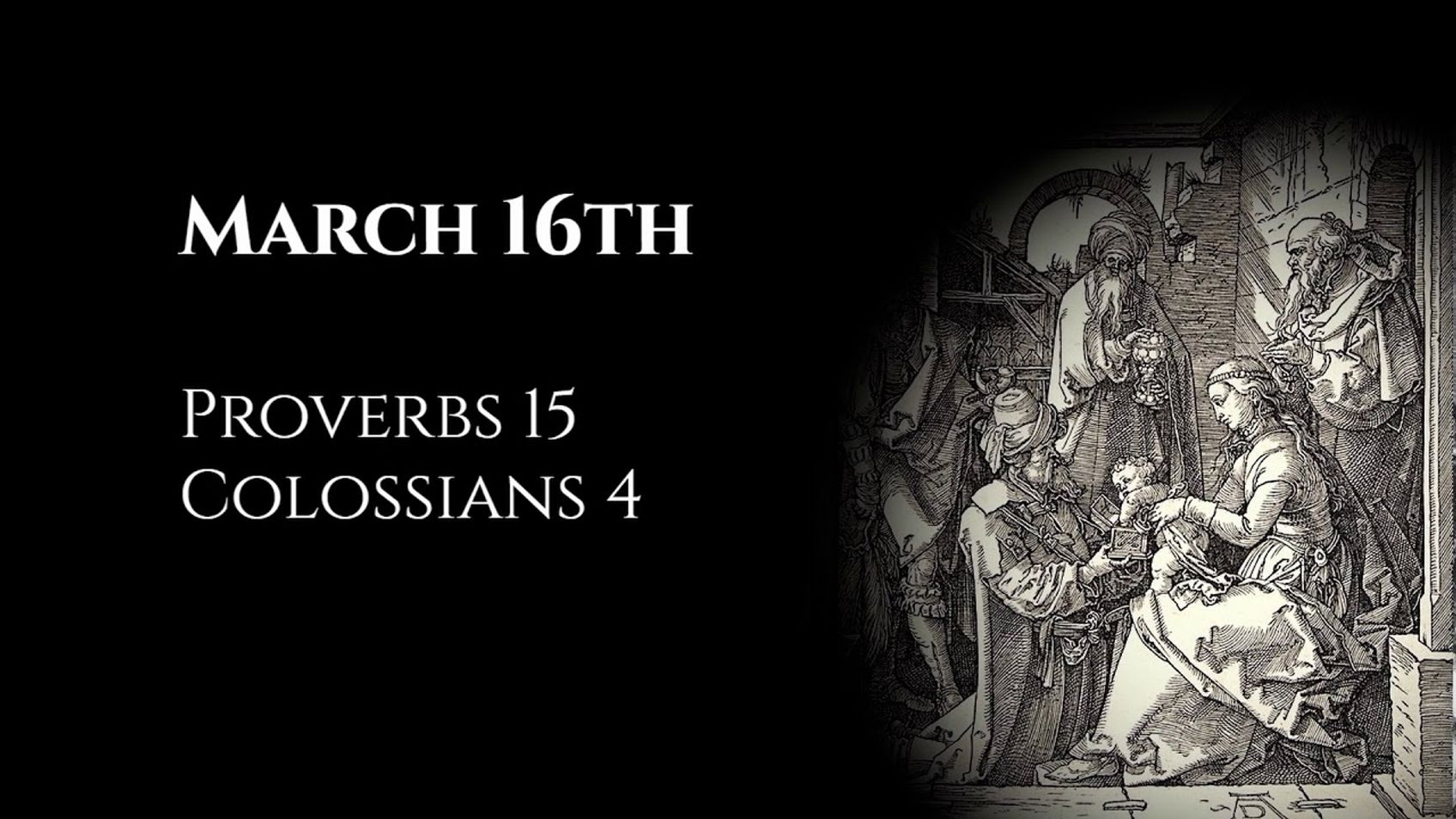
March 16th: Proverbs 15 & Colossians 4

Alastair Roberts
00:00
00:00

March 16th: Proverbs 15 & Colossians 4

March 15, 2021
Alastair Roberts
Alastair Roberts

What is the fear of the Lord? Paul's final messages to the Colossians.

Reflections upon the readings from the ACNA Book of Common Prayer (http://bcp2019.anglicanchurch.net/).

If you have enjoyed my output, please tell your friends. If you are interested in supporting my videos and podcasts and my research more generally, please consider supporting my work on Patreon (https://www.patreon.com/zugzwanged), using my PayPal account (https://bit.ly/2RLaUcB), or by buying books for my research on Amazon (https://www.amazon.co.uk/hz/wishlist/ls/36WVSWCK4X33O?ref_=wl_share).

The audio of all of my videos is available on my Soundcloud account: https://soundcloud.com/alastairadversaria. You can also listen to the audio of these episodes on iTunes: https://itunes.apple.com/gb/podcast/alastairs-adversaria/id1416351035?mt=2.

Share

Transcript

Proverbs chapter 15. In the house of the righteous there is much treasure, but trouble befalls the income of the wicked. The lips of the wise spread knowledge, not so the hearts of fools.
The sacrifice
of the wicked is an abomination to the Lord, but the prayer of the upright is acceptable to him. The way of the wicked is an abomination to the Lord, but he loves him who pursues righteousness. There is severe discipline for him who forsakes the way.
Whoever hates
reproof will die. Sheol and Abaddon lie open before the Lord. How much more the hearts of the children of man! A scoffer does not like to be reproved.
He will not go to the
wise. A glad heart makes a cheerful face, but by sorrow of heart the spirit is crushed. The heart of him who has understanding seeks knowledge, but the mouths of fools feed on folly.
All the days of the afflicted are evil, but the cheerful of heart has a continual
feast. Better is a little with the fear of the Lord than great treasure and trouble with it. Better is a dinner of herbs where love is than a fattened ox and hatred with it.
A hot-tempered man stirs up strife, but he who is slow to anger quiets contention. The way of a sluggard is like a hedge of thorns, but the path of the upright is a level highway. A wise son makes a glad father, but a foolish man despises his mother.
Folly is a joy to
him who lacks sense, but a man of understanding walks straight ahead. Without counsel plans fail, but with many advisers they succeed. To make an apt answer is a joy to a man, and a word in season how good it is.
The path of life leads upward for the prudent, that
he may turn away from Sheol beneath. The Lord tears down the house of the proud, but maintains the widow's boundaries. The thoughts of the wicked are an abomination to the Lord, but gracious words are pure.
Whoever is greedy for unjust gain troubles his own household,
but he who hates bribes will live. The heart of the righteous ponders how to answer, but the mouth of the wicked pours out evil things. The Lord is far from the wicked, but he hears the prayer of the righteous.
The light of the eyes rejoices the heart, and good news
refreshes the bones. The ear that listens to life-giving reproof will dwell among the wise. Whoever ignores instruction despises himself, but he who listens to reproof gains intelligence.
The fear of the Lord is instruction in wisdom, and humility comes before honour.
The control of one's spirit and one's tongue is essential to wisdom. The quick-tempered person will tend to incite others' anger, and will also respond to other people's anger with his own anger.
Proverbs 15.1 presents an alternative, the person who responds to
wrath with a gentle answer. If you control your own spirit, you will also be able to de-escalate emotionally fraught and volatile situations. The person who is able to speak calmly in such situations can dramatically change their dynamics.
The wise person who
has such rhetorical skill and mastery will rightly make knowledge seem attractive. When you see someone who speaks with such wisdom, you will likely desire such control of your own tongue and mastery of speech for yourself. By contrast, the fool gushes forth folly.
Instead of the finely controlled tongue, the fool vomits out his foolishness. Like the wise he makes his heart evident in the process, but not in a way that commends it to anyone. A spur to wisdom is knowing that God sees all that we do.
He sees what we do, and who
we are in the secret place. He sees the unfeigned self. The wise person, mindful that they are seen by God, acts accordingly and develops deep integrity.
The evil person characteristically
acts in a way that ignores this fact. When out of the sight of others they indulge in sin while putting on a good appearance elsewhere. The hidden secrets of hearts are, however, revealed in due time.
The gentle tongue can heal, like the tree of life. We've had a similar
proverb to this in chapter 12 verse 18. There is one whose rash words are like sword thrusts, but the tongue of the wise brings healing.
By contrast, the tongue of the perverse is
violent. It damages and injures others. Verses 5 to 12 particularly concern formative instruction.
Verse 5 expresses the truth that we've encountered in various forms elsewhere, and is a relatively straightforward antithetical parallelism. The blessings of righteousness include the profit that it brings, especially when contrasted with wickedness. The wise don't just have wisdom for themselves, but they scatter it abroad to others.
By contrast, the heart
of fools is disordered. It has no knowledge to disperse. Bare religious ritual and service, apart from a right disposition of the heart towards the Lord, is worthless.
This is a
point made in several forms in the Old Testament, in 1 Samuel chapter 15 verse 22. And Samuel said, Has the Lord as great delight in burnt offerings and sacrifices, as in obeying the voice of the Lord? Behold, to obey is better than sacrifice, and to listen than the fat of rams. The wicked person may go through the most extravagant motions, offering the greatest of sacrifices.
However, if he is not offering his heart to the Lord, the sacrifice
itself is an abomination. Isaiah chapter 1 verses 11 to 15 speak about this. What to me is the multitude of your sacrifices, saith the Lord? I have had enough of burnt offerings of rams and the fat of well-fed beasts.
I do not delight in the blood of bulls, or of
lambs, or of goats. When you come to appear before me, who has required of you this trampling of my courts? Bring no more vain offerings. Incense is an abomination to me, new moon and Sabbath, and the calling of convocations.
I cannot endure iniquity and solemn assembly.
Your new moons and your appointed feasts my soul hates. They have become a burden to me.
I am weary of bearing them. When you spread out your hands, I will hide my eyes from you. Even though you make many prayers, I will not listen.
Your hands are full of blood.
True sacrifice ought to be a sort of enacted prayer, confirmed in practice in which the offerer presents himself and his works to the Lord. This verse is not opposing prayer and sacrifice, these two things belong together, rather it is underlining what true prayer and sacrifice entail.
Verse 9 is paired with the proverb that preceded it. If the sacrifice
and prayer of the wicked is an abomination to the Lord, so is the way of the wicked. Both the wicked person's vertical worship and his horizontal way are abhorrent to God.
The pairing of these two proverbs also suggests the integrity of worship and way that should be characteristic of the righteous. When we first encounter them, discipline and reproof can be resisted and rejected. However, those who consistently reject reproof and discipline will ultimately face unavoidable discipline and reproof as they suffer the final bitter consequences of their chosen course.
The person who hates reproof will suffer the ultimate
and decisive judgment in the form of death itself. In verse 3 we were told that the eyes of the Lord are everywhere, watching the good and the wicked. In verse 11 his sight extends to the grave of Sheol and Abaddon, the place of destruction.
By implication these are realms
to which he will condemn the wicked, whose hearts are no less open and exposed to him. Hebrews 4, verses 12-13 declares, For the word of God is living and active, sharper than any two-edged sword, piercing to the division of soul and of spirit, of joints and of marrow, and discerning the thoughts and intentions of the heart. And no creature is hidden from his sight, but all are naked and exposed to the eyes of him to whom we must give account.
Wisdom is out there in the world. It is in the voice of parents, in the counsel of the wise, in the word of the law, in the company of the righteous and in many other such places. Besides having a heart that is unreceptive to wisdom, the fool will generally develop ways to avoid being exposed to wisdom, which he greatly dislikes.
Scoffing is a defensive
mechanism against wisdom. Whenever he starts to feel the uncomfortable gravity of wisdom, the fool will employ the levity of scoffing. He will also use it to ridicule the wise, rather than learn from them.
Proverbs 14, verses 7 declares, Leave the presence of a fool,
for there you do not meet words of knowledge. One of the reasons why this holds true is the fool is so allergic to wisdom. Out of this allergy to wisdom, the fool will avoid the wise, and for their part the wise know better than to tarry in the presence of fools.
The heart has a powerful effect upon a person's appearance and upon their spirit. The downcast heart will be seen in a person's countenance and also in their depressed manner. Conversely, the glad heart will be seen in a lively manner and in a cheerful face.
The heart colours everything
else. The wise have hearts hungry for knowledge, but fools have mouths that feed on folly. The implication here may be that the fool's mouth feeds on folly in his constant speaking of foolishness, whereas the wise man seeks knowledge by inner meditation upon the truth, by ruminating upon the word of God.
Verse 15 highlights the importance of the inner condition over the outer. The person who is joyful in heart will be like someone enjoying a continual feast, irrespective of the external circumstances that he experiences. Verses 16 and 17 which follow underline the importance of the state of a person's heart over their outward situations.
A heart that
fears the Lord and loves its neighbour with little material wealth is greatly to be preferred to great wealth and fine meals without these things. Proverbs 4.23 counseled, Keep your heart with all vigilance, for from it flow the springs of life. These verses provide just another reason why this counsel is so important.
Verse 1 declared, Now the same principle is pressed further. It's related to the characters behind the words. The hot-tempered man gives harsh words, but the man who is slow to anger can give the soft answer.
The one who masters his own spirit can also be the master of his words
and consequently the master of situations. The sluggard who wishes to avoid all exertion feels his way to be nothing but insurmountable obstacles. By contrast, uprightness and diligence will lead to one's way seeming smooth, straight and easy.
As Michael Fox observes, there are other potential interpretations here. The sluggard's chosen path is difficult. By laziness, procrastination and avoidance of labour, the sluggard ends up condemning himself to a much more difficult path than that of the diligent.
If he had
set about his work diligently and straight away, he would find it much easier than he does in the end. Another possibility is that the sluggard's way is a hedge of thorns because he, unlike the upright, has never cleared it. His laziness again makes things harder for him than they need to be.
Verse 20 recalls earlier proverbs in the collection, in chapter 10 verse 1 especially which opens this collection, but also in chapter 12 verse 1 and 13 verse 1. This is followed by another proverb tracing back folly and wisdom to the desires and loves of the heart. The fool finds joy in his folly, but the wise man walks on a straight path, by implication because he loves wisdom. Counselors are important for wise deliberation.
The fool simply wants to
be confirmed in his way. He will mostly listen to flatterers and shut his ears to anyone else. However, the wise man will seek a multitude of advisors.
He will be careful not merely
to listen to one set of voices. He wants various wise perspectives, so that informed by these in his deliberations, he can adopt a wise path. He won't just look for whatever expert agrees with him, but will search for wise voices of various viewpoints and test them against each other.
The plans of people that have been so formed and tested are much more
likely to succeed. Being able to give a word in season, knowingly to speak the right thing as the right person in the right place and at the right time, is a great hallmark of wisdom. It's essential to the proper use of the proverbs themselves.
The wise man appreciates
that there is more to the truth than merely a statement being true in the abstract. To speak is to act. It's to deliver a specific truth in a specific context with a specific end.
A claim that is true in the abstract may easily be the wrong thing to say at a
given time. The wise are keenly alert to this, and this is one of the respects in which they have mastered their tongues. The stakes of the life of wisdom are great.
The prudent
person is not merely seeking benefit in this present life, but following the path of life upwards, moving away from the domain of death and the grave towards enduring fellowship with God. The Lord intervenes in history against the proud, bringing down oppressors that vaunt themselves over and prey upon others. Here the pair is that of the proud and the widow, one of the most vulnerable figures.
The Lord acts against the proud and for the
sake of the widow. He tears down the former and he establishes the latter. Elsewhere in Scripture, the Lord presents himself as the guardian of the widow and the fatherless.
He fills the place where the male guardian would otherwise have been. The Lord finds the plans of the wicked abhorrent, which is one of the reasons why he acts in judgment against them. However, gracious words are pure and delightful to him.
The Lord is pleased
with the lips of the wise. In verse 25, the house of the proud is torn down by the Lord, and in verse 27, the greedy bring trouble upon their household by pursuing unjust gain. From the antithetical parallel, this unjust gain is presumably received from bribes.
Such
bribes would pervert justice and gain favour at the expense of others. The wicked and the righteous are the subject of verses 28 and 29. Once more, in verse 28, we see the difference between the righteous man, who weighs his words, and the wicked, who just vomits out his evil.
The Lord abhors the wicked and is far from them. He doesn't
hear them. However, he delights in the well-governed heart of the righteous, and he hears such a man's prayers.
The person bringing good news enlivens others.
Bruce Waltke suggests that the messenger bringing good news reveals the goodness of his news in his eyes, and when that news is received, its effect is felt throughout the whole body of the receiver. Fox differs.
He argues that it is the sight of the eyes that is intended
here, referring to what one sees, not to the light in another person's eyes. Reprove gives life, and the person who heeds it and seeks it out will dwell among the wise. He will seek out their company, but he will also become one of them in time.
The Book of Proverbs often unmasks the true character of the desires and the practices of fools. In Proverbs 8, verse 36, for instance, wisdom declares that those who hate her love death. They may not realise it, but that is what they truly desire.
We like to presume
that we know the true character of our desires. However, there are times when, after foolishly pursuing our desires and having tasted their bitter fruit, we might say, that really wasn't what I was looking for. Proverbs tends to put this rather differently.
The bitter fruit
reveals what the foolish desire was about from the beginning. The person who ignores instruction is proud. The last thing that we might think is that he despises himself.
However, if he does not despise himself, why is he running headlong and unheeding towards his own utter ruin? The one who heeds reproof by implication is the man who truly respects himself. Throughout the Book of Proverbs and the other wisdom literature, the fear of the Lord is especially held forth as that which is most fundamentally characteristic of wisdom. Different places foreground different facets of the fear of the Lord.
It can be seen as an honouring
of the Lord's teaching, in Proverbs 1, verse 7, for instance. The fear of the Lord is the beginning of knowledge. Fools despise wisdom and instruction.
Psalm 112, verse 1, connects
this with delighting in the Lord's commandments. Praise the Lord! Blessed is the man who fears the Lord, who greatly delights in His commandments. In Proverbs 8, verse 13, it is hatred of evil, especially seen in pride, arrogance and perverted speech, that comes to the foreground.
The
fear of the Lord is hatred of evil, pride and arrogance and the way of evil and perverted speech I hate. Job 28, verse 28, emphasises a shewing of evil in this connection. And he said to man, Behold the fear of the Lord, that is wisdom, and to turn away from evil is understanding.
A sense of reverence for the Lord in His holiness is the emphasis in
chapter 9, verse 10 of Proverbs. The fear of the Lord is the beginning of wisdom and the knowledge of the Holy One is insight. In our passage, it is humility that is especially emphasised.
The fear of the Lord is manifest in a humble heart. Proverbs 22, verse 4, draws
a similar connection. The reward for humility and fear of the Lord is riches and honour and life.
The humility in question is a humility arising out of a profound consciousness of
God. Such a humble person is a person who considers himself in the light of and in the sight of God. His humility is one of honouring the Lord over all else.
He is contrite in
spirit. He trembles at the Lord's word. For this reason the Lord's commandments are His meditation and His delight, heeded over all other voices.
His heart is not lifted up.
However, he fears the Lord rather than man. When we think of humility, we can often focus on it as a trait inherent in someone, rather than seeing it primarily as a responsive and relative posture to someone else.
The humble person, we might think, is simply deferential,
submissive, unassertive, obliging and nice more generally. However, the humility of the person with the fear of the Lord is such that he fears the Lord over all others. Such a person can be firm, assertive, uncompromising and bold precisely out of this humility.
His
heart is captured by a sense of the Lord's holiness. He dares not ignore the Lord's word. Such a person is not proud, arrogant or exalted in his own mind, but he will humbly stand firm against, resist, oppose, offend and even hurt others, rather than dare to disobey his Lord.
A question to consider, what are some ways in which we can cultivate this sort of humility and avoid various counterfeits? Colossians chapter 4 Masters, treat your bond-servants justly and fairly, knowing that you also have a Master in heaven. Continue steadfastly in prayer, being watchful in it with thanksgiving. At the same time pray also for us that God may open to us a door for the word, to declare the mystery of Christ, on account of which I am in prison, that I may make it clear which is how I ought to speak.
Walk in wisdom toward outsiders, making the best use of the time. Let your speech always be gracious, seasoned with salt, so that you may know how you ought to answer each person. Tychicus will tell you all about my activities.
He is a beloved brother and faithful minister
and fellow-servant in the Lord. I have sent him to you for this very purpose, that you may know how we are, and that he may encourage your hearts, and with him Anesimus, our faithful and beloved brother, who is one of you. They will tell you of everything that has taken place here.
Aristarchus,
my fellow-prisoner, greets you, and Mark, the cousin of Barnabas, concerning whom you have received instructions. If he comes to you, welcome him. And Jesus, who is called Justice.
These are
the only men of the circumcision among my fellow-workers for the kingdom of God, and they have been a comfort to me. Epaphras, who is one of you, a servant of Christ Jesus, greets you, always struggling on your behalf in his prayers, that you may stand mature and fully assured in all the will of God. For I bear him witness that he has worked hard for you, and for those in Laodicea and in Hierapolis.
Luke, the beloved physician, greets you, as does Demas. Give my
greetings to the brothers at Laodicea, and to Nympha and the church in her house. And when this letter has been read among you, have it also read in the church of the Laodiceans, and see that you also read the letter from Laodicea.
And say to Archippus, see that you fulfil the ministry that
you have received in the Lord. I, Paul, write this greeting with my own hand. Remember my chains.
Grace be with you. Paul continues his instructions concerning proper household order at the beginning of chapter 4, before concluding his epistle with requests and greetings. A well-ordered household is a matter that is addressed on several occasions in the New Testament.
The church itself is a household, and its members have their own households. Especially in this stage of the church's history, much of its life would have occurred within the realm of households, with wealthier members hosting a congregation within their house, and supporting its ministers and ministries as patrons. Nympha, in this very chapter, is an example of a woman who hosts a church within her house.
When we think of the household, we may think of a domestic realm of
retreat from the world of work, study, and public life, where we recharge ourselves and enjoy the company of our immediate family. It's a realm primarily of recreation. However, in the world within which Paul is writing, the household was a very great deal more than that.
Our own society
is more of a historical outlier in this respect. The household was far more integral to society, a centre of labour, business, and government. The household was its own economy and productive entity, within which its members needed to depend upon good order and collaborative labour in order to survive and thrive.
It wasn't the case that the man typically went out to work while the woman
stayed at home as the housewife. Households weren't narrowly focused on the young nuclear family, but were more extended and intergenerational in their character. Much that occurred in many households would be more analogous to the operations of a medium-sized company today.
At points, God's government is understood after the analogy of the management of a household. God is a father, and his fatherhood in the wider cosmos is analogous to the place of the father within his earthly household. All of this is important to bear in mind when we are reading these household codes, which have a fair amount in common with some other household codes in the world.
Aristotle or Xenophon's teaching on the household, and concerning men and women within it,
have many points of similarity with the New Testament's, and we should beware of overstating the differences. Even though there most definitely are some differences, in many respects Paul is nearer to that world than he is to ours. When we read about wives submitting to their husbands, for instance, we should keep the form of the household in mind.
Within the ancient household,
the free man bore a weighty set of responsibilities of provision, protection and judgment, in overseeing the labour and relations of his household. The submission of his wife is not primarily about giving him the deciding vote in matters of dispute, as some understand it today, but in honouring, upholding and counselling him as she works alongside him in the labour of forming a well-ordered and just household that impacts the wider society. The ideal is that, as she supports him, his realm of influence and weight in the wider society will increase, and as his wise and supportive second-in-command, she will enjoy a growing field for her own labours and level of honour within her community.
A wife who is constantly undercutting the authority of her
husband in his household, or bringing dishonour to him in their community, is not a good wife. On the other hand, and this is perhaps where the distinctive emphases of the Christian teaching are most pronounced, a man who does not exercise his authority within his household in a way governed by love, building up and encouraging those within it, is failing in his calling. The formation of the household is a collaborative effort, and the primary locus of both the man and the woman's labour.
It is a rather different situation from the modern situation where men and women typically
both leave their homes and sell the best part of their labour and its fruits to unrelated persons, in order to serve the business enterprises of third parties, rather than labouring in their own households, before returning home to consume some of the money that they have earned at the end of the day and over the weekend. While it may be strange of us to think of it in such a manner, certain aspects of our situation are more analogous to that of high-status slaves, and there are analogies to be drawn between the modern business owner and the master of slaves, both of whom might exert considerable power over those who work under them. Paul does not condemn the owning of slaves.
While a slave-owning society is none ideal,
much as a society that imprisons people, it is not presented as necessarily sinful within the Old or New Testaments. In both Testaments there are a number of righteous slave-owners. In neither Testament is there any straightforward condemnation of slavery.
The institution of slavery in the
world more generally, and in classical antiquity more particularly, was brutal and oppressive in its general character, although the conditions of slave could vary markedly, and many would have enjoyed materially better conditions than those of poor free persons. Manumission would not have been a step up in the world for many slaves. For all of its common abuses, it was also more morally complex than the chattel slavery characteristic of the American antebellum south, which was a form of slavery generally ordered around race and man-stealing.
That
form of slavery, which is very clearly condemned categorically within Scripture, tends to serve as our paradigm for thinking about slavery more generally. It should not do so. When, as here in verse 1, Paul addresses slave-owners, his concern is not to abolish the institution, but to leaven it by love.
Slave-owners need to treat their servants
with fairness and with justice. In Ephesians 6, verse 9, masters are charged to stop threatening their servants. Masters must recognise that they too have a master in heaven.
By this reminder,
Paul is leavening the institution of slavery by the golden rule. So whatever you wish that others would do to you, do also to them, for this is the law and the prophets, and by Christ's principle of judgment. For with the judgment you pronounce, you will be judged, and with the measure you use, it will be measured to you.
Masters, you have a master in heaven.
Treat your servants accordingly. Servants are instructed to act towards their earthly masters as those working heartily for the Lord, promised a great inheritance as sons.
The truth of Christian freedom and of sonship must guide them. For masters, it is the principle of Christian service that is most pronounced. They must act towards their servants as those who are themselves bondservants of Christ, accountable to him, and answerable for how they treat other persons made in God's image.
For as Paul reminds the Ephesians,
there is no partiality with God. The status of the slave-owner does not exalt him over others in God's sight, or give him some greater dignity, or allow him to treat others with impunity. Paul charges the Colossians to continue steadfastly in prayer.
Watchfulness and thanksgiving
are the order of the day. Watchfulness to the signs of God's work and the needs of the times, and thankfulness for the manifold blessings of God. Prayer is a constant work of the Church and for Christians, a sustained communication with God in our labours and lives.
Paul is especially concerned for the success
and the progress of the Gospel mission. He requests their prayer for an open door for the Word. The Word here is almost personified, as if it were someone seeking to gain access to certain closed realms.
The Word must be spread and avenues must be opened for it.
However intercession is an essential part of how such avenues will be opened, how hearts will be made receptive, how opportunities will be presented, how possibilities will arise. This is all for the sake of declaring the mystery of Christ, of which Paul spoke earlier in the Epistle.
Paul is in prison on account of this, but as he argues in 2 Timothy
2.9, the Word of God is not bound. In Philippians, for instance, Paul speaks of ways in which his imprisonment actually opened unexpected doors for the Gospel. The doors that God will open for His Word may not be the ones that we expect.
Paul is a herald of the mystery,
and it is his task to reveal it, to make it clear. He asks the Colossians to pray also for this, that he might fulfil his calling in this crucial respect. The Colossians are to be mindful and wise in the ways that they act in the sight of their society.
The quality
of their lives will be foundational for the success of their witness. This requires goodness and moral courage, but it also requires wisdom and creativity, as there will be pitfalls and traps and difficult decisions to be made. Faithfulness often requires wisdom, the ability to perceive the best courses of action, to take the right stance, and to perceive subtle errors.
The Colossians must be especially considerate of how they use their time and
how they use their speech. The verb translated making the best use of here is the same as that which is used in Ephesians 5.16. In both places, I think that the sense of the verb that some translations capture with the translation redeeming is present, although it is clearer in Ephesians 5, where we are told that they are supposed to do this as the days are evil. In times dominated by wickedness, Christians must not simply maximise the Christian activities within their day planners, but they must resist the ways of thinking of and employing time that surround them, and must establish different patterns and habits and practices.
They must
relate their time to the coming day of the Lord with watchfulness. They must punctuate their time with rest and thanksgiving. They must more fully root themselves in God's works in the past, and look with renewed hope to further horizons in the future.
They
must, in ages of decadence, sacrifice for that future. They must, in ages of revolution, honour their fathers and mothers. In such ways they will redeem the time in evil days.
Their speech must likewise exhibit wisdom and grace. It must have the savour of salt, being lively with truth. In a world of insipid error, Christians must bring words that have salience and power, words that stand out.
This requires us to learn how to communicate
words of truth with eloquence, passion and integrity. In societies where words are light, the words of Christians must be weighty. Knowing how to answer each person is a challenge, and we need to grow in wisdom in this area.
The words that we speak must vary according
to the persons and context that we address. The wise person must speak considered and measured words in season, not speaking rashly or carelessly. The conclusion of the epistle contains elements familiar from others of Paul's epistles.
Travel plans, greetings from various persons, final instructions, personal notes and a benediction. James Dunne, following Roy Yates, remarks upon the great social mix of the people represented in this chapter. Large householders, nympha, a doctor, Luke, people with sufficient financial freedom or support to travel in the work of the gospel, Tychicus, Mark, an Epaphras, and slaves, Anesimus.
There are also various descriptions such as fellow worker, minister,
brother, fellow servant and fellow prisoner. Tychicus is bearing the epistle, and he will also bring news of Paul to the Colossians. Paul commends him to them with the intent that he will not only communicate how Paul and the others are doing, but that he will be able to minister to them.
Tychicus is accompanied by Anesimus. This is likely the
occasion of the sending of the epistle to Philemon, and all save the names of Philemon and Apphia in the epistle to Philemon are also mentioned here. Anesimus is one of them, he is a Colossian, but now he is one of them in a deeper way, as a Christian.
Tychicus,
who is privy to more of the details, can explain anything that needs further explanation about Anesimus' situation and of what transpired. Paul sends greetings from six of his fellow workers, three Jews, Aristarchus, Mark, the cousin of Barnabas, and Jesus called Justus, and three Gentiles, Epaphras, Luke, and Demas. Aristarchus is described as Paul's fellow prisoner, most likely literally.
Mark, the cousin of Barnabas, was formerly a cause of
division between Paul and Barnabas in Acts chapter 15 verses 37-40. Now Barnabas wanted to take with them John called Mark, but Paul thought best not to take with them one who had withdrawn from them in Pamphylia and had not gone with them to the work. And there arose a sharp disagreement, so that they separated from each other.
Barnabas took Mark with him
and sailed away to Cyprus, but Paul chose Silas and departed, having been commended by the brothers to the grace of the Lord. Mark's mother owned a large house in the city of Jerusalem, and this is the first time that we hear of his relationship with Barnabas, although it makes a lot more sense of the details of their connection elsewhere. Now it seems Paul has been reconciled to Mark, and recognises his value.
It isn't clear whether
Mark is the author of the second epistle, but the belief that he was has been very widely held throughout church history. Epaphras is the one who has worked among the Colossians and in the surrounding region of Hierapolis and Laodicea. Paul might not yet have met the Colossians, but Epaphras has told him all about them, and is in constant prayer for them.
Paul also has Luke and Demas with him. If the Mark mentioned here is the author of
the second gospel, then we have reference to two gospel writers being in the same place as Paul, the author of the vast majority of the epistles of the New Testament. Almost 60% of the New Testament was written by these three men.
We also learn that Luke was a physician.
Sadly, in 2 Timothy 4.10 we learn the tragic news that Demas later forsook Paul, in love with this present world. Paul wants the Colossians to pass on these greetings to the Christians in Laodicea too, and to Nympha and the church meeting in her house.
There is quite a lot
of debate over whether Nympha was a woman, or whether the person Paul is speaking of is Nymphas, a man, as the manuscript tradition has both forms within it. Not much depends upon this point however. Possibly Paul has yet to visit Laodicea, which is why he can single out Nympha and the church at her house without fear of privileging her over others in the congregation.
Laodicea is of course one of the seven churches addressed in the
book of Revelation. They are instructed to pass on the epistle to the Laodiceans, from whom it will presumably circulate more widely. They were also to read the letter that the Laodiceans had received, presumably from Paul, which a number of scholars believe is the epistle to the Ephesians.
These epistles would be read publicly to the congregations of the
churches, and then they would be circulated further, presumably becoming gathered in small volumes quite early on. They expressed Paul's apostolic authority, and they also knit the young church more closely together, by encouraging lots of movement between congregations with these circulating letters. At this time then, it is likely that the Colossians would have received the epistle to the Ephesians, the epistle to the Colossians, and the epistle to Philemon.
One was directly addressed to them as a church, one was addressed to a particular
member of the Colossian church, and the other was passed on from another church nearby. Archippus, who is also mentioned in the epistle of Philemon, is charged to fulfil the ministry that he has received. We don't know what this was, but perhaps it was some particular role in the church that met at Philemon's house.
Paul signs off the letter with his own hand,
having presumably used an amanuensis to this point. He calls upon them to remember his chains. His imprisonment was a mark of his apostolic ministry, and his union with Christ in his sufferings in serving the church.
They also highlighted his need for prayer. He
concludes by wishing them God's grace. A question to consider.
How might Paul's instructions concerning the use of time and
speech remind us of the wisdom books of the Old Testament?

More on OpenTheo

Corey Miller: The Progressive Miseducation of America
Knight & Rose Show
September 27, 2025
Wintery Knight and Desert Rose welcome Dr. Corey Miller to discuss The Progressive Miseducation of America. They examine how universities promote scie
When Is It Time to Walk Away from a Conversation?
#STRask
September 1, 2025
Questions about how to discern when it’s time to walk away from a conversation, and how to cope with people charging you with being prideful and legal
John Thomson and the Shaping of American Presbyterianism with Stephen A. Fix
Life and Books and Everything
September 29, 2025
If you are looking for a deep dive into the history of early American Presbyterianism, you have come to the right place! Listen in as Kevin talks with
“Jesus Had Two Dads, and He Turned Out Just Fine”
#STRask
August 28, 2025
Questions about how to engage someone wearing a button that reads, “Jesus had two dads, and he turned out just fine,” and how to be kind and loving wi
Conservatism and Religious Freedom with John Wilsey
Life and Books and Everything
October 27, 2025
What is conservatism? And why does it go hand in hand with religious freedom? How should we think about the American experiment of ordered liberty? Ha
Terrell Clemmons: Legacy of the Scopes Monkey Trial
Knight & Rose Show
August 16, 2025
Wintery Knight and Desert Rose welcome Terrell Clemmons to discuss the 100th anniversary of the Scopes Monkey Trial. We discuss Charles Darwin’s theor
Should I Leave a Church That Refuses to Preach on Divisive Topics?
#STRask
August 21, 2025
Questions about leaving a church with biblical theology because they refuse to preach on divisive topics, whether it’s okay to write an apologetics bo
After the Crucifixion, was Jesus Resurrected or Rescued? Licona vs. Ally
Risen Jesus
October 8, 2025
This episode is a 2016 debate held at the University of Tennessee – Chattanooga between Dr. Michael Licona and Dr. Shabir Ally, president of the Islam
The Historical Reliability of the Gospels: Licona vs. Ehrman - Part 2
Risen Jesus
September 10, 2025
In this episode, frequent debate opponents Dr. Michael Licona and Dr. Bart Ehrman face off on the historical reliability of the gospels. Held in 2018
How Do These Passages Fit with Your View on How God Speaks?
#STRask
September 15, 2025
Questions about why, if it’s impossible to miss God’s voice, the disciples incorrectly told Paul “through the Spirit” not to go to Jerusalem, people m
Why Does the Bible Teach You How to Be a Proper Slave Owner?
#STRask
November 13, 2025
Question about why it seems like the Bible teaches you how to be a proper slave owner rather than than saying, “Stop it. Give them freedom.”   * It s
How Do I Reconcile the Image of God as Judge with His Love, Grace, and Kindness?
#STRask
October 20, 2025
Questions about how to reconcile the image of God as a judge with his love, grace, and kindness, why our sins are considered to be sins against God, a
Did Jesus Lie in Mark 5:39?
#STRask
August 18, 2025
Questions about whether Jesus lied in Mark 5:39, proving that lying can’t be a sin, when he said, “The child has not died, but is asleep,” and what Je
What Are the Top Three Apologist Pitfalls to Watch Out For?
#STRask
October 2, 2025
Question about the top three pitfalls to watch out for when you start using apologetics in conversations with others.   * What are the top three apol
The Golden Thread of the Western Tradition with Allen Guelzo
Life and Books and Everything
October 6, 2025
Dr. Guelzo is back once again for another record setting appearance on LBE. Although he just moved across the country, Allen still made time to talk t