OpenTheo

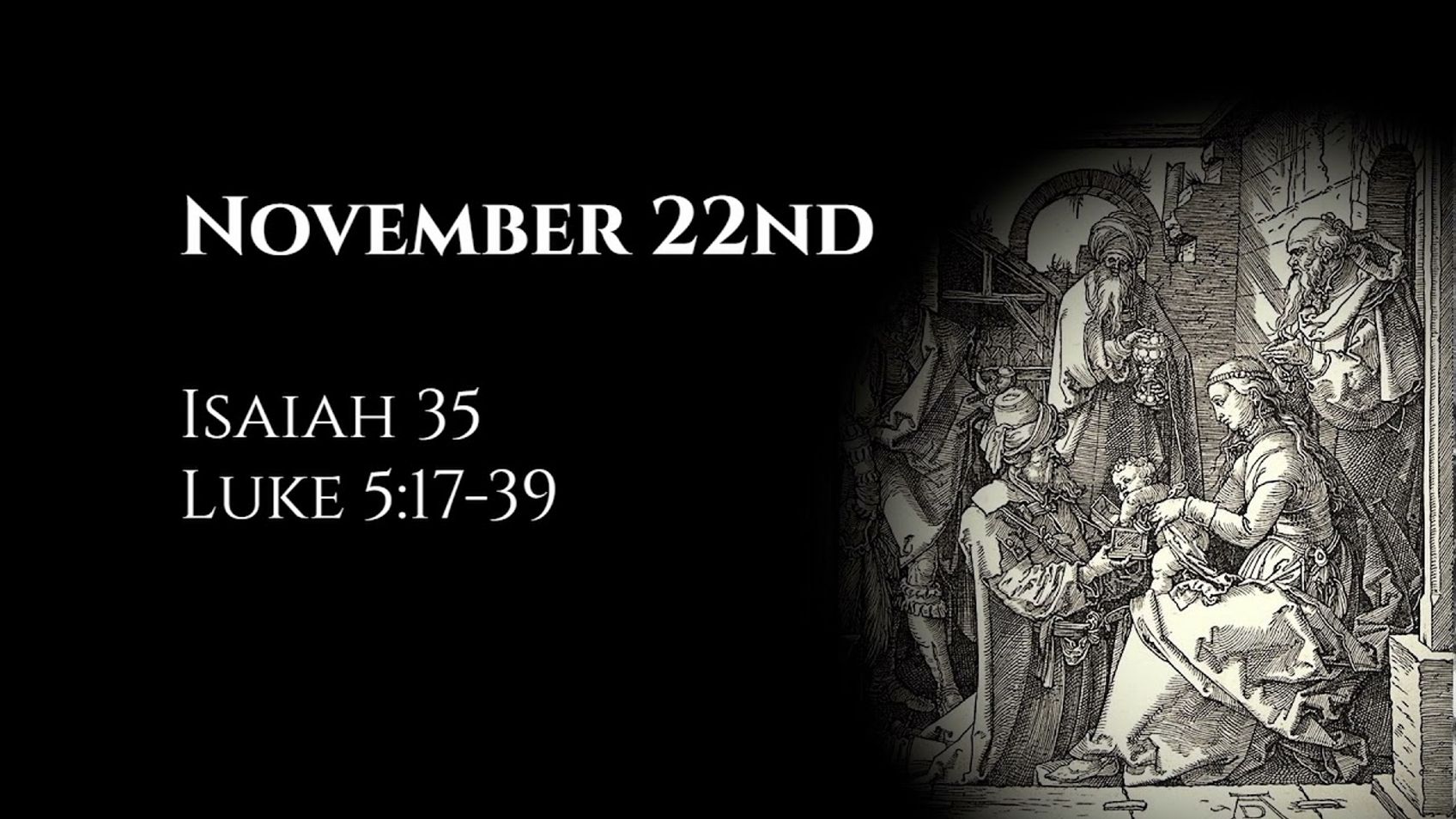
November 22nd: Isaiah 35 & Luke 5:17-39

Alastair Roberts
00:00
00:00

November 22nd: Isaiah 35 & Luke 5:17-39

November 21, 2021
Alastair Roberts
Alastair Roberts

The desert blooming! Jesus challenged by the scribes and Pharisees.

My reflections are searchable by Bible chapter here: https://audio.alastairadversaria.com/explore/.
If you are interested in supporting this project, please consider supporting my work on Patreon (https://www.patreon.com/zugzwanged), using my PayPal account (https://bit.ly/2RLaUcB), or buying books for my research on Amazon (https://www.amazon.co.uk/hz/wishlist/ls/36WVSWCK4X33O?ref_=wl_share).

You can also listen to the audio of these episodes on iTunes: https://itunes.apple.com/gb/podcast/alastairs-adversaria/id1416351035?mt=2.

Share

Transcript

Isaiah chapter 35. God will come with vengeance, with the recompense of God. He will come and save you.
Then the eyes of the blind shall be opened, and the ears of the deaf unstopped. Then shall the lame man leap like a deer, and the tongue of the mute sing for joy. For waters break forth in the wilderness, and streams in the desert.
The burning sand shall become a pool, and the thirsty ground springs of water. In the haunt of jackals, where they lie down, the grass shall become reeds and rushes, and a highway shall be there, and it shall be called the way of holiness. The unclean shall not pass over it.
It shall belong to those who walk on the way. Even if they are fools, they shall not go astray. No lion shall be there, nor shall any ravenous beast come up on it.
They shall not be found there, but the redeemed shall walk there. And the ransomed of the Lord shall return and come to Zion with singing. Everlasting joy shall be upon their heads.
They shall obtain gladness and joy, and sorrow and sighing shall flee away. Isaiah chapters 34 and 35 conclude the body of prophecies that ran from chapter 28 to 33 and also the larger section beginning with the oracles against the nations in chapter 13. These two chapters are more general, global and cosmic in their scope.
They're also important in the larger structure of the book. Chapter 34 especially recalls chapter 13, but chapter 35 anticipates the later material of the book, in chapters 40 to 66, a fact that has led a majority of less conservative scholars to attribute it to a later hand. There are certainly close comparisons to be drawn between the language and themes of this chapter and those of later chapters.
Much in this chapter anticipates passages like chapter 40 verses 1 to 11, and then verse 10 is almost identically repeated in chapter 51 verse 11. And the ransomed of the Lord shall return and come to Zion with singing. Everlasting joy shall be upon their heads.
They shall obtain gladness and joy, and sorrow and sighing shall flee away. Of course, such commonalities do not demand the theory that this passage comes from a later date, while any who believe in Isaiah's authorship of the entire book, for instance, certainly have some difficult challenges to that position to address. Explaining commonalities of language between some material in chapters 1 to 39 and chapters 40 to 66 definitely isn't one of them.
Likewise lines of supposed dependence can generally just as readily be reversed. For those scholars who hold that other hands were involved in the writing of Isaiah, later material could have been informed by earlier material such as this chapter. While the unity of these two chapters is also questioned by some scholars, they are in fact tightly connected.
Chapter 34 spoke of the devastating judgment that would come upon the earth and those doomed to destruction, which the nation of Edom, Judah's near neighbor, particularly represented. In contrast to the devastation of the land of Edom, at the end of the preceding chapter, chapter 35 speaks of the healing and the fruitfulness of a once barren land. Joseph Blenkinsop writes of these chapters, The contrast embodies the theme of eschatological reversal stated more incisively in the last section of the book, for instance, chapter 65 verses 13 and 14.
Whereas Edom will be turned into an uninhabited wasteland, the Judean wilderness and arid land will bloom like Lebanon and Carmel. The contrast is worked out in some detail. The wadis of Edom will be turned into pitch.
Wadis of the Israelite land, now barren, will have a plentiful water supply. Chapter 34 verse 9 and 35 verse 6. Nettles and thistles are contrasted with reeds and rushes, plants that grow near water. Chapter 34 verse 13 and 35 verse 7b.
Jackals and other unpleasant animals will take over in Edom. They will lose their habitat in the transformed Israelite wilderness. Chapter 34 verse 13, chapter 35 verse 7b and 9. There will be no way of traveling through Edom.
There will be a highway for all except the richly unclean in the transformed land of Zion. Chapter 34 verse 10b and chapter 35 verse 8. Blenkinsop concludes, a close reading will confirm the detailed correspondence between the contrasting images. Chapters 34 and 35 therefore form a coherent unit that juxtaposes the fate of hostile powers with the ultimate salvation of Zion, a juxtaposition found elsewhere in the book, especially in the last 11 chapters.
The vision of the future here seems to look towards a greater, more eschatological horizon, a more general restoration of the creation, of which there are anticipations in time, in such events as the return from exile in Babylon. The desert here, as John Oswald argues, should probably not be identified with any desert in particular. It is rather a symbol of that which is barren and fruitless, lacking the means to sustain life.
The Lord's coming and grace can transform the driest and least hospitable place into a verdant and beautiful garden that is filled with bounty. He can transform the lamenting of his people into joyful song. When the Lord arrives on the scene, the whole earth will take on a renewed and transfigured aspect.
Lebanon, Carmel and Sharon, typically especially fruitful parts of the land, were described in chapter 33 verse 9. The land mourns and languishes. Lebanon is confounded and withers away. Sharon is like a desert, and Bashan and Carmel shake off their leaves.
Now however, for their drought and mourning will come the rain of divine blessing and the joy of new life. The glory of Lebanon and the majesty of Carmel and Sharon that they will receive are here directly related to the glory and majesty of the Lord. The glory of these lands are reflections of the Lord's smile upon them.
As they see the Lord's splendor, they start to bear some small measure of his likeness. The people were earlier described as hopeless, despairing and fearful, having lost all energy and confidence. Verses 3 and 4 encourage them to lift up their downcast hearts, to strengthen their weakened limbs and to await with confidence the Lord's action in their situation.
His vengeance and recompense, described in verse 8 of the preceding chapter, is at hand. There is no need to be dismayed or to languish in fear any longer. Their deliverance is nigh.
When the Lord comes, disabilities will be miraculously healed. Those who were once incapacitated or disabled will arise with a surge of strength. The blind will see the death here.
Back in chapter 6 verses 9 and 10, the Lord had declared a judgment upon his people where they would lose their senses. Go and say to this people, keep on hearing but do not understand. Keep on seeing but do not perceive.
Make the heart of this people dull and their ears heavy and blind their eyes lest they see with their eyes and hear with their ears and understand with their hearts and turn and be healed. In the opening of eyes and ears, this judgment, among other things, is being reversed. Lame men will leap.
Mute men will sing like babbling brooks bursting forth in a parched desert. Imagery of waters in the wilderness extends the theme of healing to include the land in addition to the people. Just as the people are filled with new life, so will their land be.
Once uninhabitable places will be made welcoming for dwelling, lush and well watered. Places that were once the haunt of scavenging beasts will become places of verdant foliage. Edom, the people devoted to destruction by the Lord, would have their land given over to wild animals and rendered impassable.
The reverse would happen to the people of the Lord. A highway would be created through the once desert lands, an image to which Isaiah returns in chapter 40 verses 3 to 5. A voice cries, In the wilderness prepare the way of the Lord. Make straight in the desert a highway for our God.
Every valley shall be lifted up and every mountain and hill be made low. The uneven ground shall become level and the rough places a plain. And the glory of the Lord shall be revealed and all flesh shall see it together.
For the mouth of the Lord has spoken. Whereas the path down to Egypt for aid described in the oracle of the beasts of the Negev in chapter 30 verse 6 was dangerous and treacherous, this path is safe and certain. It is a way that belongs to the righteous.
The unclean cannot walk on it, nor can the fools stumble upon it. Upon that path people will enjoy safety from all predators. Isaiah previously spoke of highways in chapter 11 verse 16 where he spoke of a highway for a remnant of exiles returning from Assyria and in chapter 19 verse 23 where a highway between Egypt and Assyria was established for worshippers.
Once again this is a highway that leads to Zion, to the worship of the Lord. We might also hear, as in those other places, reminders of the story of the exodus and the journey through the wilderness to the promised land, the highway that the Lord is establishing. It is a highway for the redeemed of his people to return to Zion.
Fittingly, this section of Isaiah ends with an eschatological image of the fullness of joy, of exiles returning and reuniting, of sorrow and sighing fleeing away and of a glorious and glad assembly of song in the holy city. A question to consider. Where do we see the New Testament referring to and using the imagery of this chapter? Luke chapter 5 verses 17 to 39 And the scribes and the Pharisees began to question saying, When Jesus perceived their thoughts he answered them, And he said to the man who was paralyzed, After this he went out and saw a tax collector named Levi sitting at the tax booth.
And he said to him, And they said to him, And Jesus said to them, He also told them a parable, And no one puts new wine into old wineskins. If he does, the new wine will burst the skins and it will be spilled, and the skins will be destroyed. But new wine must be put into fresh wineskins.
And no one after drinking old wine desires new, for he says, In the second half of Luke chapter 5 Jesus performs a healing, followed by a series of confrontations with and questions from the religious authorities. The same sequence of events is found in Matthew chapter 9 and also in Mark chapter 2. And here for the first time in the Gospel of Luke, Jesus' conflict with the religious leaders is coming to the foreground. It's the first time that we see the Pharisees and the teachers of the law in the context of Jesus' ministry.
While Jesus is teaching and healing some men bring to him a paralytic on a bed. And the crowd is so great that they cannot approach him, so they have to remove the tiled roof above him and lower the man down to him. They overcome the obstacles of the crowd and the roof to reach Jesus.
Their faith in this instance is seen in their persistence and their confidence that Christ has the power and the willingness to heal. And the refusal to let anything stand in the way of reaching him. Jesus responds to their faith by declaring the sins of the paralysed man forgiven.
To this point in Luke we might have even got the impression that Jesus' ministry was primarily about healings and exorcisms. But here we see an act of forgiveness. And in that act of forgiveness some aspect of Jesus' ministry that goes beyond healing and exorcism is revealed.
There is a far more powerful work of salvation that's taking place here. The scribes and the Pharisees however think that he's blaspheming. He's claiming a prerogative that is God's alone.
To forgive sins, surely that's only something that God can do. Who can forgive sins but God alone? And Jesus recognises what's in their hearts and his response is to demonstrate his authority by healing the man. That healing is not the greater act.
The greater act and the central act is the act of forgiveness. And that is part of the surprise of this chapter. We think that the central event will be the healing of the paralysed man.
But the healing of the paralysed man takes place almost as an afterthought. As a demonstration of the deeper healing that has taken place within. That two-stage healing is an inward then an outward healing.
The outward healing as a sign of the inward healing. And this helps us to understand Jesus' ministry more generally. Jesus' ministry of external healing, of exorcism and these sorts of things are signs of the coming kingdom.
A kingdom that reaches far deeper in the salvation that it brings. Jesus speaks of himself as the Son of Man. The Son of Man has authority on earth to forgive sins.
Jesus is acting in this particular capacity. The Son of Man is a figure of eschatological significance. But he's not just a judge.
He's also someone who brings forgiveness.
The Son of Man in Daniel chapter 7 was one given great authority. One who would judge and rule.
But Jesus presents the establishment of the kingdom and the authority of the Son of Man as being exercised in part through forgiveness. The physical healings demonstrate Christ's authority and are signs of the deeper healing that's taking place. The work that Jesus is accomplishing however is not just that of an itinerant healer.
Rather he is the one who is the Son of Man bringing the eschatological kingdom and bringing forgiveness to God's people. And the response of the people is that they are filled with amazement and awe. That they glorify God for the works that he is doing.
That they are witnessing. Some time after this Jesus sees Levi sitting at the tax booth as a tax collector. In Matthew's Gospel we're told that the tax collector was Matthew and presumably Levi is another name by which he goes.
The tax collectors were despised for collaborating with the Romans and also for their injustice. They dealt closely with the Gentiles and they dealt with an imperial oppressor. And they would be seen as complicit in that oppression.
An oppression that had a religious significance not merely in the way that it mistreated the poor but also in the way that it held the people of God in bondage. And so for Jesus to eat not just with Levi but with a great company of tax collectors would be seen as a matter of considerable scandal. One of the themes that will become apparent as we go through the book of Luke is the importance of meals and the events that happen at tables.
Jesus is redefining Israel around the meal table. The meal table is among other things an anticipation of that great wedding feast. And as in the story of the paralytic we need to see some of the deeper themes of Jesus' ministry come to the surface here.
In the story of the paralytic it's the importance of forgiveness and the way in which the healings are pointing towards a deeper healing that Christ is accomplishing. Here we need to see the way that Christ is gathering the lost sheep of the house of Israel. Those who need a physician.
Those who are sinners and sick. And he is bringing restoration and forgiveness to them. Following this Jesus is questioned concerning fasting.
Fasting would be a standard religious practice of Jewish groups and the fact that Jesus' disciples abstain from it is surprising. Surely a great rabbi like Jesus would teach his disciples to fast regularly. But fasting is a matter of timing.
You fast in preparation for the feast. And when the bridegroom is on the scene fasting would be a great failure to realise what time you're in. Christ is the bridegroom.
God has visited his people in Christ. And those who appreciate this visitation will feast and celebrate. The time however will come when the bridegroom will be taken from them and then they will fast.
While there were anticipations of Christ's death in the statement of Simeon in his presentation in the temple. And also on the occasion when his parents lost him in Jerusalem at the time of the Passover. Here however it is turning up in Jesus' own teaching.
Jesus' teaching concerning the new and the old garments and the new wine and the old wineskins. Expresses something of the insufficiency of the old structures containing the new work that he is bringing about. Jesus' teaching is not that the old is bad or to be rejected.
But rather that it cannot contain the new thing that he is bringing. Christ fulfills the law but in a way that goes beyond the constraining structures of the law. If you tried to contain the new wine of Jesus' ministry in the old wine of the practices of the disciples of John the Baptist or the Pharisees.
And the other practices of the law it would burst those old wineskins. Likewise if you took the fabric of the kingdom and used it to patch the old reality of Israel. It would tear and both would be the worst for it.
No, Jesus is bringing something new that cannot be reduced to, contained by or constrained by. The reality that has gone beforehand. It fulfills it but it cannot be circumscribed by it.
The final statement of this passage. And no one after drinking old wine desires new for he says the old is good. Is probably an ironic statement.
In this statement Jesus is probably commenting upon the way that people are rejecting him and the new wine of the kingdom. Because of their failure to see beyond the old wine of the old covenant. A question to consider.
How might Jesus' miraculous turning of the water into wine in the wedding cana in John chapter 2 shed light upon this particular passage and vice versa?

More on OpenTheo

Licona and Martin: A Dialogue on Jesus' Claim of Divinity
Risen Jesus
May 14, 2025
In this episode, Dr. Mike Licona and Dr. Dale Martin discuss their differing views of Jesus’ claim of divinity. Licona proposes that “it is more proba
How Is Prophecy About the Messiah Recognized?
#STRask
May 19, 2025
Questions about how to recognize prophecies about the Messiah in the Old Testament and whether or not Paul is just making Scripture say what he wants
What Questions Should I Ask Someone Who Believes in a Higher Power?
#STRask
May 26, 2025
Questions about what to ask someone who believes merely in a “higher power,” how to make a case for the existence of the afterlife, and whether or not
What Do Statistical Mechanics Have to Say About Jesus' Bodily Resurrection? Licona vs. Cavin - Part 1
Risen Jesus
July 23, 2025
The following episode is a debate from 2012 at Antioch Church in Temecula, California, between Dr. Licona and philosophy professor Dr. R. Greg Cavin o
Why Would We Need to Be in a Fallen World to Fully Know God?
#STRask
July 21, 2025
Questions about why, if Adam and Eve were in perfect community with God, we would need to be in a fallen world to fully know God, and why God cursed n
Could Inherently Sinful Humans Have Accurately Recorded the Word of God?
#STRask
July 7, 2025
Questions about whether or not inherently sinful humans could have accurately recorded the Word of God, whether the words about Moses in Acts 7:22 and
Is It Wrong to Feel Satisfaction at the Thought of Some Atheists Being Humbled Before Christ?
#STRask
June 9, 2025
Questions about whether it’s wrong to feel a sense of satisfaction at the thought of some atheists being humbled before Christ when their time comes,
What Should I Say to Someone Who Believes Zodiac Signs Determine Personality?
#STRask
June 5, 2025
Questions about how to respond to a family member who believes Zodiac signs determine personality and what to say to a co-worker who believes aliens c
Where’s the Line Between Science and Witchcraft?
#STRask
July 31, 2025
Questions about what qualifies as witchcraft, where the line is between witchcraft and science manipulating nature to accomplish things, whether the d
What Would You Say to an Atheist Who Claims to Lack a Worldview?
#STRask
July 17, 2025
Questions about how to handle a conversation with an atheist who claims to lack a worldview, and how to respond to someone who accuses you of being “s
How Can I Tell My Patients They’re Giving Christianity a Negative Reputation?
#STRask
August 7, 2025
Questions about whether there’s a gracious way to explain to manipulative and demanding patients that they’re giving Christianity a negative reputatio
What Do Statistical Mechanics Have to Say About Jesus' Bodily Resurrection? Licona vs. Cavin - Part 2
Risen Jesus
July 30, 2025
The following episode is a debate from 2012 at Antioch Church in Temecula, California, between Dr. Licona and philosophy professor Dr. R. Greg Cavin o
What Should I Say to My Single, Christian Friend Who Is Planning to Use IVF to Have a Baby?
#STRask
August 11, 2025
Questions about giving a biblical perspective to a single friend who is a relatively new Christian and is planning to use IVF to have a baby, and whet
What Should I Teach My Students About Worldviews?
#STRask
June 2, 2025
Question about how to go about teaching students about worldviews, what a worldview is, how to identify one, how to show that the Christian worldview
Full Preterism/Dispensationalism: Hermeneutics that Crucified Jesus
For The King
June 29, 2025
Full Preterism is heresy and many forms of Dispensationalism is as well. We hope to show why both are insufficient for understanding biblical prophecy