OpenTheo

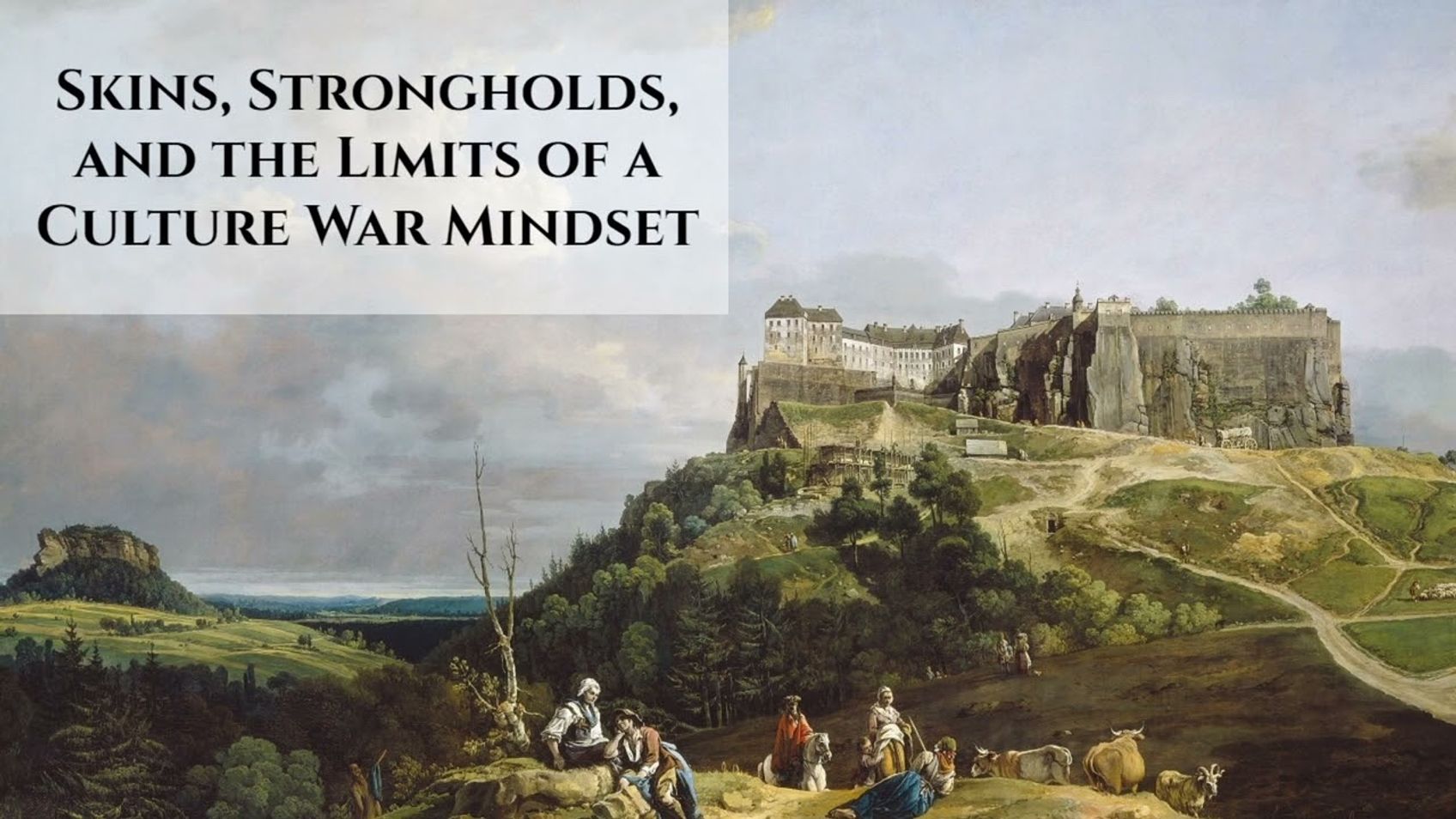
Skins, Strongholds, and the Limits of a Culture War Mindset

Alastair Roberts
00:00
00:00

Skins, Strongholds, and the Limits of a Culture War Mindset

May 25, 2022
Alastair Roberts
Alastair Roberts

If you are interested in supporting my work, please consider becoming a patron on Patreon (https://www.patreon.com/zugzwanged), donating using my PayPal account (https://bit.ly/2RLaUcB), or buying books for my research on Amazon (https://www.amazon.co.uk/hz/wishlist/ls/36WVSWCK4X33O?ref_=wl_share).

You can also listen to the audio of these episodes on iTunes: https://itunes.apple.com/gb/podcast/alastairs-adversaria/id1416351035?mt=2.

Share

Transcript

In my recent video on social media and the lack of boundaries, I commented upon such issues as the danger of decontextualized Christian speech, which addresses the culture as such. I discussed the way that social media radically dissolves contexts. It makes people reactive as their identities and affiliations are exposed, and this vastly exaggerates the importance of political speech, as people increasingly address themselves to the culture as such, rather than to their more specific contexts.
Where the dissolving or collapsing of contexts has occurred, politics can become increasingly totalizing for people's identities, communities, and speech. One of the most important aspects of the Church's political witness in the current climate will be in the fact that the overwhelming majority of its witness is not political. A successful Christian witness will recontextualize a lot of issues that in a decontextualized world become strongly political.
We need clear and firm voices that speak to the political and social evils of our day, but we also need these to be contextualized by a preoccupying focus upon the immediate duties under our noses, to prayer, to worship, to the study of scripture, to service of our neighbour, and to being faithful in the exact place that we find ourselves. Now there will be ideological and political forces present within those realms, but the idea that those forces are encountered in this abstract form of the culture as such is erroneous, and can lead to a tendency to try and look through everything with suspicion, trying to see the ideology and the politics that lurks behind everything, rather than actually dealing with what is in front of our noses. Liam Bright recently tweeted, The more that they will tend to reveal hidden non-ideological facets to their characters and beliefs, if you approach them in the right way, if you get to know them, a lot of their ideological convictions will be seen to be a lot thinner than they actually first appeared.
Once this has been recognized, there can be seen to be a lot more potential for persuasion and communication than might at first appear. This of course will not be so obvious to those who fixate upon the culture as such, and always see the ideologies lurking behind the particulars of any given situation. Persons can easily be seen as avatars for the ideologies that they subscribe to, or events can be boiled down to symbols of narratives.
But when you focus upon the concrete reality in front of you without so much suspicion, without denying or pull to ideologies and narratives, it greatly decreases the emphasis that we all put upon them. There are so many other features at work that do not register on the level of the grand spectacle with which we are all preoccupied on social media. The closer that you look, the more of life can be seen to be not straightforwardly ideological or political, even those parts that seem, at first glance, to be the most ideological and political.
Often those ideologies and politics can be substituting for things that are missing elsewhere, and the more that we identify the root issue, the more that we'll be able to defuse the political and the ideological fixations far more successfully than if we went directly for them. I have often spoken about the importance of deradicalisation, of breaking things down to size, so that we recognise ideological and political problems, but we do not exaggerate them. Rather than suspicion seeing politics and ideology behind everything else, perhaps we should exercise a lot more of that suspicion towards our politics and ideology, suspecting that, when closely examined, they are not actually the totalising forces that they might seem to be, but result in no small measure from the decontextualisation of our discourse and the way in which everything gets projected onto or channelled into these realms of speech.
The more that we recontextualise, break down to size, and bound things, the more that we'll find that ideology and politics lose their pull and their explanatory power. They may more be symptoms of the breakdown of our context than the causes of all of our problems. A further duty of recontextualisation is recognising the bounds of our own particular activity and calling.
The Christian faith is not politically quietest. It speaks to governments and it speaks to authorities and tells them things that they need to do. However, Christians are called to submit even to bad authorities and to aspire to lead a quiet life.
Most of us, almost all of us, are not called to engage with the front line of politics and should not become overly preoccupied with its spectacles. We can consider the things of politics, but they should not encroach upon our understanding of life to the extent that they do nowadays. The dangerous decontextualisation of thought and speech is also seen in our forgetting of where, what, and who we are, and what, who, and where we are addressing.
We can fall into some dangerous traps of thought and speech here. So, for instance, I have all sorts of informed theological opinions on the way that various things should be run in the church. However, while these things may be carefully considered, there's still largely private judgements that comes down to it.
My duty is mostly just to submit to my own church's government, even if it's bad. If I were a pastor or a priest, even if less informed, my judgements would be of a very different character. I would have some authority to execute many of them, and people might have to submit whatever their own private judgements of their merits.
There is a certain sort of person who spends lots of time thinking about politics and or theology, and because of the honed character of their opinions, they think that they enjoy special privileges of private judgement, things that justify insubordination to authority. This can often be betrayed by the way that we frame our questions. Should we celebrate weekly communion? What should our Covid policies be? However informed our private opinions on these matters, very few of us are in the position of actually making the judgements concerning these policies for our church or state.
This doesn't mean that there aren't good reasons that churches and states should consider informing these policies. Scripture speaks to many of these, for instance, as does reason and science. However, almost all of us are private opinionators.
Our duty is mostly to submit and to honour the authorities over us.
Now, we may have some part to play in electing those representatives who will execute judgements in our polities. Some of us may even be counsellors to authorities in positions of power.
At certain points, we may be participants in public deliberations. However, in all of these cases, we need to recognise the limitations of private judgement, and the fact that we are mostly not the ones tasked with making these judgements, but are to submit to and honour those who do. While we can use the means that are open to us as private individuals to seek to persuade, to petition, to appeal, and even legally to protest, we need to be very wary of decontextualising these questions, of forgetting the positions from which we are asking them, positions of those who are mostly subject to authority, not wielding it.
There is a constant danger of those who have studied theology or politics in detail to be very bad at being subject to those who are in authority over them. And so much of this arises from forgetfulness of context. I have argued for the importance of having defined and relatively bounded and grounded contexts, and directed discourse.
And without these, we will increasingly speak from nowhere to the culture in general. We will constantly feel exposed to a totalising, zero-sum political fight. It seems to me that in such a way of seeing the world, any challenge to the so-called right will be seen as an action for the sake of the left, and then there will be an imperative that we train the vast majority of our firepower upon those sins perceived to be dominant in the culture, which are generally seen to be the sins of the left.
My argument is that as we try and bound our discourse and focus it, speaking into very immediate and concrete horizons, rather than the horizon of the culture as such, we will be able to speak far more effectively to the issues that Christians face, even those of the surrounding culture. A pastor, for instance, needs to address the Christian message to the consciences of his congregation. The government is not in attendance.
Christians' political adversaries are not in attendance.
Even their unbelieving neighbours are very unlikely to be in attendance. And such a pastor needs carefully and consistently to challenge those sins that are most likely to take root in the lives and the hearts of his heroes.
He needs to shepherd the flock that's committed to him. He will probably have to tread a careful line here. He will have, on the one hand, to speak about the sins of non-Christians and of Christians elsewhere on occasions.
But he will need to do so in a way that does not make his congregation feel self-righteous. He must generally be harder upon the sins of insiders. It's also important that he speak to people where they are.
He needs to build the relational capital of trust and goodwill with them. When evils in the society encroach upon their lives, he should speak about those evils and tell them that they are evil. Yet his concern should always be to return them to a focus upon their own duties.
Doing this well typically requires a certain sort of so-called winsomeness. The typical faithful pastor is more concerned to address weeds growing in his own garden, but will generally have gently to ease them out rather than pulling them out forcefully. Few pastors are belligerent and confrontational in addressing their own people's sins.
This is not a problem, provided that those sins are being addressed. When the culture becomes the all-consuming horizon, sin increasingly comes to be presented as if it were cheaply a problem with various groups of outsiders. Pride and related behaviours soon can follow.
If someone is a pastor of a church where most people are right-leaning, the preaching of that church and its teaching should really challenge the right and the sins to which it is prone. While recognising and speaking of the sins in the wider society that surrounds them, pastors of such churches are mostly tasked to prepare their own congregations for faithful witness in their surroundings. And that faithful witness will be found in performing their own moral duties.
This doesn't mean that the sins of the so-called right are greater than those of the left, nor the two sets of sins in competition. The pastor isn't called to fight the culture war. He's simply to address the flock committed to his charge, wherever they may be, in their specific situation.
And the people within that congregation may be quite unrepresentative of the wider culture. Many of us have all sorts of strong thoughts and feelings on various sins and errors of the culture as such, or of the left, for instance. But we have limited occasions to voice them.
If we do not have many people on the left in our immediate contexts, then addressing the left may not be something that our calling often demands. We need to learn to live and to speak into our own small corners. Now, thinking about all of this, one of the first concerns that might arise, and it's not an illegitimate one, is that I am failing to take into account that people are constantly being bombarded by the culture.
We need regularly and loudly to speak about the sins of the culture to which people are exposed. But this, I think, is where my approach is most important. I've often used the illustration of skin to describe the sorts of boundaries that we need.
Skin provides both a boundary against and an interface with the world that surrounds us, whatever that world might be. Skin is part of what enables us to preserve some degree of a homeostatic balance in our bodies, even as we move through various environments. Without skin, we would need to cut ourselves off entirely from an impure world, or ideologically sterilise the world, or be in constant aggressive immune reaction to the world.
We might just succumb to the world. One of my chief concerns is that, recognizing the hostility of our wider cultural environments, many conservative Christians merely ramp up an aggressive immune reaction, which is so aggressive that it often misrecognizes true parts of the body itself as enemies. What people have failed to address is Christians' desperate need for a skin.
So much of the aggression that people manifest on social media and elsewhere is because their psychologies and communities feel radically exposed, vulnerable, and insecure. They feel besieged. And especially this will occur as people's identities are situated on social media, where they are constantly being exposed to hostile opinion.
When you look at people who are psychologically healthy, what you'll usually notice is that the most formative realms of their existence, of their identities, are realms that are secure. In those realms where they find their existential centre of balance, they do not feel under threat. However, those who are caught up with all sorts of hostile yet vague forces in a wider world will constantly be reactive.
They have few boundaries to protect them.
Our various worlds and cultural environments are definitely hostile to Christianity, and increasingly so in these days. But I believe that our most urgent concern is to develop healthy boundaries, to start with our own souls.
If you feel psychologically exposed and vulnerable to hostile opinion on social media, you should probably get off it. In addition to skin, another analogy here might be that of a stronghold. Mark Sayers, in his book None Anxious Presence, speaks about these strongholds as protective structures created by humans to insulate us from external threats and to reduce our anxiety.
The problem with social media is that we are constantly bombarded by external threats. We have not actually built a stronghold. And so if you want to be healthy, if you want to be non-reactive, if you don't want to be constantly caught up in paranoid and suspicious relationships with the wider world, create a stronghold.
Try to develop, as a matter of first priority, a skin for yourself. We need to pursue the perfect peace of those whose minds are stayed on guard. We can have disagreements on Twitter and Facebook and elsewhere without being unhealthily, psychologically and socially exposed to them.
This is a great way to avoid the rancour that comes with reactivity. It's saddening to me to see how many people's sense of the urgency of the cultural war causes them to lose sight of just how increasingly important it is at such times to develop a healthy skin for our minds, to avoid reactivity, and to pursue a homeostasis of the heart. When Christians feel psychologically and otherwise exposed to the culture, it's all the more important that they learn regularly to withdraw to their own closets, to seek the Lord's face and to study His word, to re-ground themselves and to build themselves a stronghold of truth within which they will feel secure, not constantly needing to be engaging in counter-bombardment against the bombardment they feel.
Christian worship needs to lift our minds above the culture and its battles to a higher kingdom. It's all the more important that Christians devote themselves to strong, shared habits of life and mutual service. If you feel constantly bombarded by the culture, then perhaps it's time to sell your television, to switch to a dumb phone, to leave social media, to spend even more time in scripture and prayer, to ground yourself ever more fully in God's truth.
Yes, cultural boundaries are falling away, and we can feel completely exposed to the great eye of the culture. So we need to mend whatever boundaries we have and to erect some new ones. And when we do this, we'll be in a much, much better position to speak to the genuine evils of our cultures in non-reactive ways, without fear and anxiety driving us, or reactivity.
We won't view everything with a great suspicion, seeing too great ideological or narrative forces in great competition against each other. We will be a lot more aware of the complexities on the ground, and the way in which these could be used to our favour. We might be in a position to do so much more good.
One of the most important tasks of pastors is to establish and protect the skin of their churches, to nurture a distinctive culture in their congregations that can remain calmly operative amidst the most fierce opposition. The culture may be hostile, but they can live in a way that is peaceful, without being fixated upon the culture, without being anxious and constantly hostile and reactive to it. And as they develop that frame of mind, they can speak a lot more effectively.
Those who go into a hostile cultural environment every day at work need to be trained in establishing healthy boundaries and strong principles of healthy life in their psychologies and in their homes. They can remain healthy in unclean environments if they have thick skins. There will definitely be many occasions where our skins are breached.
It's not as if our skins do away with our need for an immune system. We will need immune systems on many of these occasions. But when we have thick skins and we know how to clean and bandage wounds, for instance, they need be much less desperately and constantly active.
Healthy life requires the differentiation of context with boundaries. Where these boundaries break down or are lacking, disorders in one realm constantly bleed into others, and anxiety and tension rule. When these boundaries are broken down, we see conflicts in one realm and we constantly project them onto a greater realm.
We see politics and ideology at play as the great defining forces, and we can lose sight of the more bounded ways in which other forces are operative, and ways in which politics and ideology do not have the final word. This can help us to disaggregate things that would otherwise be lumped in together. The more that people fixate upon politics and ideology, the more that lots of different things get lumped together in single realities.
We see various ideological extremes as the full and truest expressions of some forces that are present even in more subtle forms elsewhere. There are genuinely some elements of fascism at certain points on the right, and people on the left see those elements and then project that onto the whole of the right, and see in the right this incipient fascism that is mostly being expressed in veiled forms. Same on the right.
The right sees in the left forces such as socialism,
and they focus upon the most extreme expressions of that, and don't consider the ways in which things are a lot more disparate and complex and variegated, and that not everything can be boiled down to one ideological force. The more that things get collapsed and abstracted, the more that dysfunctions in one realm will bleed into all others. An argument on social media will unsettle one's mood for the rest of the day.
Unfair treatment from the boss gets taken out of one's spouse or children. Opposition in the culture increasingly preoccupies the church, distracting it from the peace and the pursuit of Christ. More than anything else at this time, when boundaries are weakening and contexts are collapsing, we need to be all the more concerned about attending to and creating them.
A faithful church will be concerned to create strongholds, skins, ways in which to shield people's identity from these constant great ideological and narrative forces that others see to be at play in the world. It will help them to demythologise these things, and to focus more and more upon that immediate realm in front of them, upon their own small corner, to be able to be faithful in that realm, to recognise where there are ideological things present, but also to be able to see past the fixation upon these as great, grand forces, and to recognise how human and rooted in flesh they are. As we take such an approach, I believe that new options will be given to us to resist some of these things that people see in the culture.
We'll be better equipped to act in effective ways. In actual fact, constantly preaching against the sins of the culture does not actually help us that much, where we have to navigate them in a personal way. When someone's child comes out as transgender, or there's a situation in the workplace where affirmation of a particular ideological group is required, in such situations you need to deal with the persons and the situation directly in front of you.
Merely fighting the battle against the culture as such leaves you largely unresourced. The challenge for so many is that these great decontextualised struggles are radically contextualised and people do not know what to do. They do not know how to love that person who's directly in front of them, because they've never really seen them as much more as a symbol within the culture wall.
So, in conclusion, what are some of the ways that we can respond to these crises when they come near to us? Here are a few suggestions. First of all, and most important of all, pray. Pray for a calm heart, for clear eyes, for a courageous spirit.
Pray for deliverance from anxiety and reactivity. Be confident that the Lord can act in such situations that seem humanly impossible. Second, before crises arise, do your best to make friends and allies wherever possible.
You will need them when the time comes, and churches should be proactively connecting with local authorities and businesses and others, asking how they can pray for them, serve their communities, and other things like that. The goodwill that this creates can be invaluable in a crisis. Ideological activists are seldom nice people, and this can also show them up.
Third, don't presume that the existence of a demand requires its enactment. Daniel existed in a situation where everyone had to eat the king's meat, and many people looking at Daniel and his friends from without might think they were hopelessly compromised, as they must have eaten the king's meat to be in the position that they were in. However, the Lord provided a way of escape for Daniel and his friends in Arioch.
Fourth, appeal in good faith to authority figures. Explain your situation and ask for and suggest some ways for you to be accommodated. Don't always presume that people are going to follow along with the ideologies in lockstep.
Many people don't hold the ideologies in anywhere near as strong a form as you might think. Fifth, recognise that many powerful people might be prepared to help you. The evilness of a system is not the same as the evilness of each and every one of its participants.
Daniel, for instance, had an ally in King Darius. Don't jump to pessimistic conclusions. Don't presume that everyone is completely ideologically possessed.
Deal with people as humans, not as avatars of ideologies, and sometimes, though often not, surprising things will happen. Sixth, churches and Christians should do whatever they can to create networks, structures, and other ways to opt out of the worst institutions. Seventh, seek counsel from other people who have dealt with such situations in other contexts.
They often have great wisdom to offer. Eighth, don't underestimate what loving your enemies can do. Don't focus on them, though.
Generally try and win over the fairer minded.
Ninth, in many of our situations, we need to get to know the law, to create and invest in structures of legal defence, support funds that protect Christians, and also that protect people more generally against cancellation. Strategically pursue various alliances.
There is generally a lot more scope than people presume for collaboration with others who differ. Tenth, discourage people from applying laws against you as Mordecai's Edict did. King Ahasuerus' Decree remained on the books, but Mordecai's Decree trumped it and made people afraid to apply it.
There are times when, wisely using the resources at our disposal, we will, without merely being litigious, be able to discourage people from taking action against us. Eleventh, we should strengthen our networks wherever possible. Try and connect with other people and support them.
Many people are finding themselves feeling besieged at the moment. Create contexts where there is a skin in supportive networks, where there is a stronghold in people gathering round and being there for each other. Finally, sociological awareness is really important.
Know what is driving current crises and where the weak points are. Don't presume it's all just ideology and politics. So much of it boils down to other forces, like economic precarity.
The ability to demythologise politics and ideology will enable us to tackle many root issues, which those who are merely focused upon what is most prominent, the politics and the ideology, will be unable to address. Because of their fixation, generally one born of anxiety and suspicion, they simply will not have the same repertoire of responses and ability to see into situations open to them. Unless the Church can resist the urge, merely reactively to fight culture wars, it will lack the ability, none anxiously, to look into its situations and to act within them in ways that are effective, hopeful and transformative.
Yes, there are dangerous cultural forces out there. Yes, there are ideologies at work within our society. Yes, there are hostile political forces.
But Christians with skin, by not fixating upon these things, will be able to address them with far greater wisdom and skill.

More on OpenTheo

Bible Study: Choices and Character in James, Part 2
Knight & Rose Show
July 12, 2025
Wintery Knight and Desert Rose study James chapters 3-5, emphasizing taming the tongue and pursuing godly wisdom. They discuss humility, patience, and
Licona vs. Fales: A Debate in 4 Parts – Part Four: Licona Responds and Q&A
Risen Jesus
June 18, 2025
Today is the final episode in our four-part series covering the 2014 debate between Dr. Michael Licona and Dr. Evan Fales. In this hour-long episode,
If Sin Is a Disease We’re Born with, How Can We Be Guilty When We Sin?
#STRask
June 19, 2025
Questions about how we can be guilty when we sin if sin is a disease we’re born with, how it can be that we’ll have free will in Heaven but not have t
Bodily Resurrection vs Consensual Realities: A Licona Craffert Debate
Risen Jesus
June 25, 2025
In today’s episode, Dr. Mike Licona debates Dr. Pieter Craffert at the University of Johannesburg. While Dr. Licona provides a positive case for the b
What Should I Say to My Single, Christian Friend Who Is Planning to Use IVF to Have a Baby?
#STRask
August 11, 2025
Questions about giving a biblical perspective to a single friend who is a relatively new Christian and is planning to use IVF to have a baby, and whet
God Didn’t Do Anything to Earn Being God, So How Did He Become So Judgmental?
#STRask
May 15, 2025
Questions about how God became so judgmental if he didn’t do anything to become God, and how we can think the flood really happened if no definition o
How Is Prophecy About the Messiah Recognized?
#STRask
May 19, 2025
Questions about how to recognize prophecies about the Messiah in the Old Testament and whether or not Paul is just making Scripture say what he wants
Did Man Create God? Licona vs Yothment
Risen Jesus
August 6, 2025
This episode is a 2006 debate between Dr. Michael Licona and Steve Yothment, the president of the Atlanta Freethought Society, on whether man created
What Would You Say to an Atheist Who Claims to Lack a Worldview?
#STRask
July 17, 2025
Questions about how to handle a conversation with an atheist who claims to lack a worldview, and how to respond to someone who accuses you of being “s
Terrell Clemmons: Legacy of the Scopes Monkey Trial
Knight & Rose Show
August 16, 2025
Wintery Knight and Desert Rose welcome Terrell Clemmons to discuss the 100th anniversary of the Scopes Monkey Trial. We discuss Charles Darwin’s theor
Why Do You Say Human Beings Are the Most Valuable Things in the Universe?
#STRask
May 29, 2025
Questions about reasons to think human beings are the most valuable things in the universe, how terms like “identity in Christ” and “child of God” can
Is God “Divided Against Himself” When He Allows Evil?
#STRask
August 14, 2025
Questions about whether the principle that a house divided against itself can’t stand would apply not only to Satan casting out demons but also to God
Shouldn’t We All Be Harvesters?
#STRask
August 4, 2025
Questions about how to handle objections from Christians who think we should all be harvesters and should not focus on gardening, and whether attendin
Full Preterism/Dispensationalism: Hermeneutics that Crucified Jesus
For The King
June 29, 2025
Full Preterism is heresy and many forms of Dispensationalism is as well. We hope to show why both are insufficient for understanding biblical prophecy
Why Would We Need to Be in a Fallen World to Fully Know God?
#STRask
July 21, 2025
Questions about why, if Adam and Eve were in perfect community with God, we would need to be in a fallen world to fully know God, and why God cursed n