OpenTheo

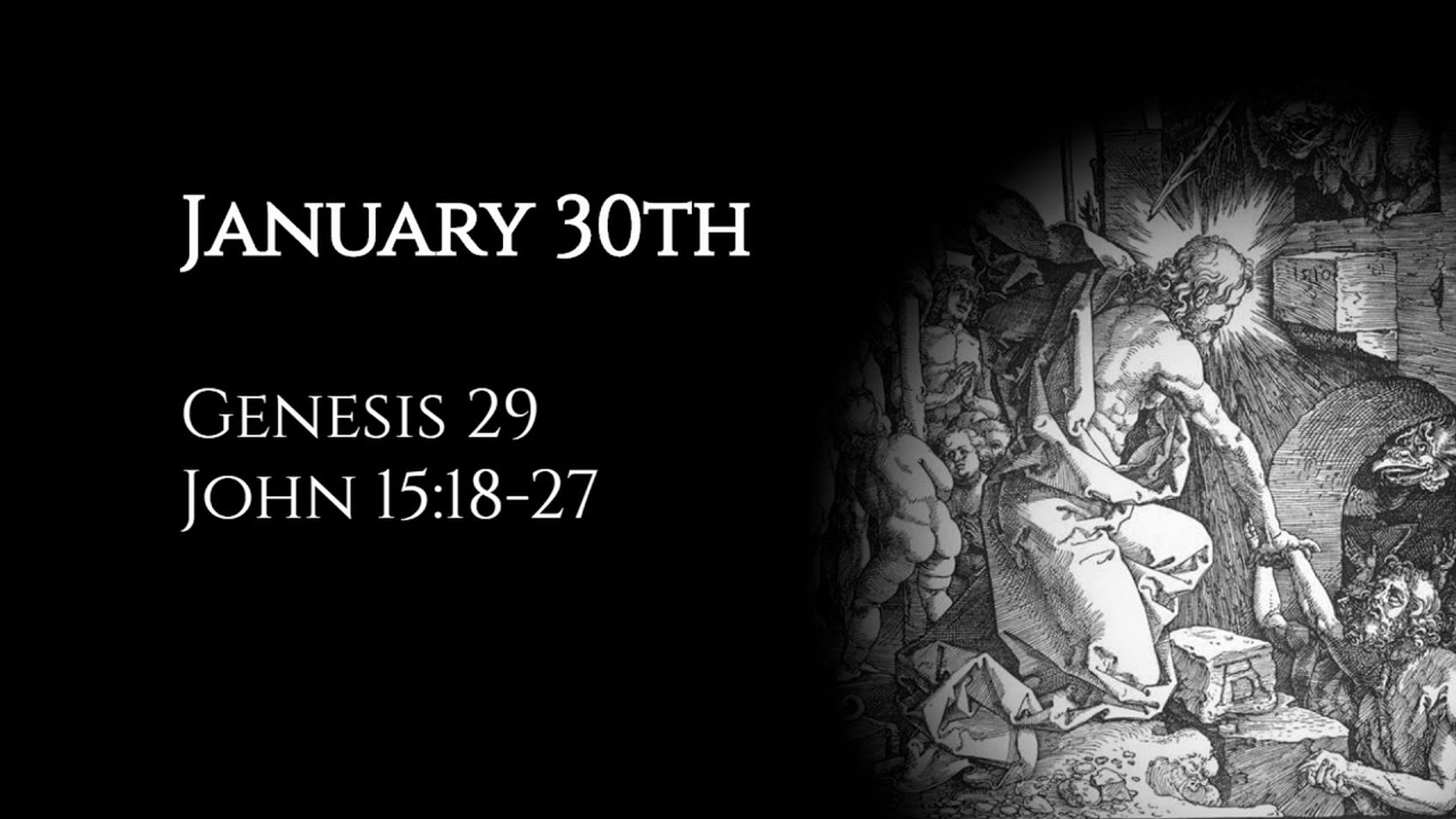
January 30th: Genesis 29 & John 15:18-27

Alastair Roberts
00:00
00:00

January 30th: Genesis 29 & John 15:18-27

January 30, 2020
Alastair Roberts
Alastair Roberts

Jacob marries Rachel and Leah. The world hates Christ and his disciples.

Reflections upon the readings from the ACNA Book of Common Prayer (http://bcp2019.anglicanchurch.net/).

If you have enjoyed my output, please tell your friends. If you are interested in supporting my videos and podcasts and my research more generally, please consider supporting my work on Patreon (https://www.patreon.com/zugzwanged), using my PayPal account (https://bit.ly/2RLaUcB), or by buying books for my research on Amazon (https://www.amazon.co.uk/hz/wishlist/ls/36WVSWCK4X33O?ref_=wl_share).

The audio of all of my videos is available on my Soundcloud account: https://soundcloud.com/alastairadversaria. You can also listen to the audio of these episodes on iTunes: https://itunes.apple.com/gb/podcast/alastairs-adversaria/id1416351035?mt=2.

Share

Transcript

Genesis 29. Then Jacob went on his journey and came to the land of the people of the east. As he looked he saw a well in the field, and behold, three flocks of sheep lying beside it.
For out of that well the flocks were watered. The stone on the well's mouth was large, and when all the flocks were gathered there, the shepherds would roll the stone from the mouth of the well and water the sheep, and put the stone back in its place over the mouth of the well.
well.
Jacob said to them, My brothers, where do you come from? They said, We are from Haran.
He said to them, Do you know Laban the son of Nahor? They said, We know him. He said to them, Is it well with him? They said, It is well, and see, Rachel his daughter is coming with the sheep.
He said, Behold, it is still high day, it is not time for the livestock
to be gathered together. Water the sheep and go, pasture them. But they said, We cannot, until all the flocks are gathered together, and the stone is rolled from the mouth of the well.
Then we water the sheep. While he was still speaking with them, Rachel came with her father's sheep, for she was a shepherdess. Now as soon as Jacob saw Rachel the daughter of Laban his mother's brother, and the sheep of Laban his mother's brother, Jacob came near, and rolled the stone from the well's mouth, and watered the flock of Laban his mother's brother.
Then Jacob
kissed Rachel, and wept aloud. And Jacob told Rachel that he was her father's kinsman, and that he was Rebekah's son. And she ran and told her father.
As soon as Laban heard the news about
Jacob his sister's son, he ran to meet him, and embraced him, and kissed him, and brought him to his house. Jacob told Laban all these things, and Laban said to him, Surely you are my bone and my flesh. And he stayed with him a month.
Then Laban said to Jacob, Because you are my kinsman, should
you therefore serve me for nothing? Tell me, what should your wages be? Now Laban had two daughters. The name of the older was Leah, and the name of the younger was Rachel. Leah's eyes were weak, but Rachel was beautiful in form and appearance.
Jacob loved Rachel, and he said, I will serve you
seven years for your younger daughter Rachel. Laban said, It is better that I give her to you, than that I should give her to any other man. Stay with me.
So Jacob served seven years for Rachel, and they
seemed to him but a few days because of the love he had for her. Then Jacob said to Laban, Give me my wife that I may go into her, for my time is completed. So Laban gathered together all the people of the place and made a feast.
But in the evening he took his daughter Leah and brought her to Jacob,
and he went into her. Laban gave his female servant Zilpah to his daughter Leah to be her servant. And in the morning, behold, it was Leah.
And Jacob said to Laban, What is this you have done to me?
Did I not serve with you for Rachel? Why then have you deceived me? Laban said, It is not so done in our country to give the younger before the firstborn. Complete the week of this one, and we will give you the other also in return for serving me another seven years. Jacob did so and completed her week.
Then Laban gave him his daughter Rachel to be his wife. Laban gave his female servant Bilhah to his daughter Rachel to be her servant. So Jacob went into Rachel also, and he loved Rachel more than Leah, and served Laban for another seven years.
When the Lord saw that Leah was hated, he opened her womb,
but Rachel was barren. And Leah conceived and bore a son, and she called his name Reuben. For she said, Because the Lord has looked upon my affliction, for now my husband will love me.
She conceived
again and bore a son, and said, Because the Lord has heard that I am hated, he has given me this son also. And she called his name Simeon. Again she conceived and bore a son, and said, Now this time my husband will be attached to me, because I have borne him three sons.
Therefore his name was called Levi.
And she conceived again and bore a son, and said, This time I will praise the Lord. Therefore she called his name Judah.
Then she ceased bearing. In Genesis chapter 29, Jacob leaves Bethel and heads
towards the land of the people of the east, Haran and the house of his uncle Laban. Once again we have surprising scenic details.
There's a well with a stone over it, and three flocks of sheep
lying beside it. Jacob asks the shepherds whether they know Laban, and is told that they do, and that his daughter Rachel is coming with the sheep. They cannot remove the stone until the flocks are gathered, and Rachel is bringing the fourth flock.
On Rachel's arrival, Jacob removes the stone and
waters the flock of Laban. Jacob greets Rachel with a kiss and weeps aloud, telling her that he was her father's kinsman and the son of Rebekah. And when Laban hears this, as Rachel runs to tell her family, he runs to meet Jacob, embraces him and kisses him.
Now there's a lot of scenic detail in this passage,
and as usual when the Bible gives us lots of seemingly superfluous scenic details, they probably aren't merely there for the purpose of painting a florid picture in our minds. It's worth bearing in mind how random, occasional and often weird the scenic details scripture gives us are. So for instance, we are told all of the ingredients of the meal that Abraham gave to the angels, but we're told virtually nothing about the physical appearance of the majority of biblical characters, including Jesus himself.
There are scenic and other details that are used very
sparingly, and usually when they're present they're there for us to pay attention to. There's a principle of drama called Chekhov's gun. The principle goes as follows.
Remove everything that
has no relevance to the story. If you say in the first chapter that there is a rifle hanging on the wall, in the second or third chapter it absolutely must go off. If it's not going to be fired, it shouldn't be hanging there.
So it is with scripture. Scripture does not give us irrelevant
story elements. Biblical narrative often involves scenic or incidental details, but those details help you to recognise connections.
So for instance, why are we told that John the Baptist dresses in
a particular way, with camel skin and a leather belt around his waist? Well, because it helps us to recognise his resemblance to Elijah. Why are we told here that there are three flocks of sheep, with a further fourth flock of sheep led by Rachel on the way? Well, one thing it helps us to do is to recognise the symmetry between the beginning of Jacob's journey to Padan and Moran, and then his return, when he divides his family into four groups, with Rachel last. In that return journey he has an encounter with God's angels at Mahanaim, which he calls God's camp.
This reminds us of the
story of Bethel in chapter 28, with Jacob's statement, this is the gate of heaven, this is the house of God. Now, what other things do we see? There's a physical feat at the sight of the water, and there's a meeting with Esau that recalls the meeting with Rachel and Laban, running out to meet him, embracing and kissing, and then also lifting up their voices and weeping. It's the same patterns that we see in the story of meeting with Rachel and Laban.
And so these scenic details help us to recognise
something more of the shape of this story, and in the shape of the story, some of the deeper themes and things that are playing out. This is a there and back again story, and once you've realised that, you'll recognise some further connections, and it will help you to see part of the meaning of what's taking place. Jacob in this chapter already seems quite transformed from the weak character of chapter 27, who could not take the initiative but had to be pushed into things by his mother.
Now he's lifting up his legs and running on his way, he can remove a great stone single-handed, and once again note Jacob's association with stones. This is something that we've seen in the previous chapter, and will continue through in his story. Beyond the change in Jacob's ability and character, maybe we should notice a further connection between a matriarch and a well, as Rachel is here encountered at a well.
We've seen the story of Hagar in the well, we've seen
the story of Rebecca in the well, later on we'll see in Exodus the story of Moses meeting with his wife at a well. And these stories are familiar patterns being played out in different forms. Now I've mentioned before that the differences between the accounts are as important as their similarities.
The meaningful differences become more apparent as the similarities become more
familiar to us. So as we've read a number of these stories we begin to see the ways in which each particular story stands out. And in this story, one of the ways it stands out from the others is that the well is blocked and needs to be opened.
It can only be opened when Rachel has arrived with
her flock. Now note the fact that it is the opening of Rachel's womb that marks the turning of the tide in the next chapter. As Rachel comes with her flock of children, there will be a change in the movement of the story.
The fruit of Rachel's womb will bring blessing for all but it will only
occur through struggle. After the other flocks have arrived it will be Rachel's flock that will come last. Rachel is described as a shepherdess, a fitting companion for one who's associated with Her name also means you or female sheep and in this story we'll see parallels between flocks of sheep and flocks as the family.
Jacob acts like Rebecca did for his grandfather Abraham's servant. So he
goes and he waters the flocks of Rachel just as Rebecca watered the flocks or the camels of Eliezer. Rachel then acts like Rebecca running and telling her family about this person who's arrived and Laban's extravagant greeting at this point is perhaps in hope of treasures from the grandson of Abraham.
He was in the previous story and remains a mercenary man but yet a month passes
and there's no great caravan of wealth coming behind Jacob. Jacob's by himself with no great treasures to his possession and then we see Jacob's status reduced by Laban. He's no longer being treated as a kinsman but more as a hired servant.
He has to work for his keep. He has to
be paid wages. He's no longer treated as Laban's bone and his flesh but as one who's working within his house for money.
Now he's not reduced to servitude and slavery but his situation is
definitely lowered at this point. He wants to serve for Rachel, Laban's youngest daughter. And Rachel is described as beautiful but Leah's eyes are delicate.
It can be translated weak or
perhaps delicate. I would prefer to go with delicate which may also suggest that they were beautiful in their own way. He serves Laban for a week of years for seven years which is later described as a week.
It feels like a few days to him. Now remember in the previous chapter that
Rebecca had told Jacob to stay for a few days in Laban's house and that she'd summon him back when the time came. Now it feels to him like this whole seven-year period is just a few days.
He loves Rachel so much. At this point he's presumably working for a bride price and the So this money would be given to Laban which Laban would hold in trust for Rachel so that if anything happened, if Jacob abandoned her or if Jacob died, Rachel would have that money as her security. But yet Laban switches Rachel with her elder sister Leah and we can think back to chapter 27.
This is the same sort of thing that happened. Rebecca has switched her two sons and now Rebecca's brother Laban switches his two daughters. He says it is not so done in our country to give the younger before the firstborn.
You can imagine that stung that Jacob knew that Laban was referring in
part to the way that he had treated his brother Esau. There is a feast, there's the switching of the two children, there's the use of darkness as a means of hiding recognition. So in the first story it's the blindness of Isaac that's the darkness.
Here it's just the darkness after the
feast. We should presume that Jacob has drunk well. It's a feast of wine that they celebrate and the drinking is something that is important to pay attention to here because we'll see references to it in the chapter that follows.
Jacob then says words to Laban that are very
similar to the words of Esau to his father. He then goes on to serve another seven years for Leah. Altogether this makes 14 years, two separate weeks of years, distinct sets, one week and then followed by another week.
We should notice that there is another example of this later on in Genesis.
It will occur again in the story of Joseph and the famine in Egypt. So keep this detail in the back of your mind for now because it will become relevant again then.
Jacob now has two rival
wives in his house, one loved and the other unloved and they're sisters but they're at odds with each other now and the repercussions of this will become central for the rest of the book of Genesis. It's a rivalry between two wives which spills over into the rivalry between two sides of a family. Later on the law will say that you should not do this.
You shall not take a wife as a
rival wife for her sister in Leviticus 18 verse 18. This is speaking very clearly to a situation like that of Jacob and Rachel and Leah. It's not an appropriate situation and we can see from the fallout of it that it is a negative choice.
There were many ways in which this led to
harmful consequences for all parties involved. Reuben, Simeon, Levi and Judah are now born and named. We should observe the way that Leah is dealing with God through the story of her child bearing.
She's in a tragic situation. She's presumably in this situation more as a result
of her father's engineering and plans and plots than of her own but God sees and remembers her even though her father has wronged her, her sister is her rival, her husband doesn't love her. God sees her as in the story of Hagar.
God remembers the outcast and has concern for the outcast.
In Genesis the names of the characters are often important for the narrative. I've already noted the way that various facets of the laughter to which Isaac's name refers is explored throughout the story and the names of Reuben, Simeon, Levi and Judah are important, the meanings that are given to them and we'll maybe see or comment upon these at some later points within the story of Genesis.
A question to think about in conclusion. It's important to remember that when we're reading
the story of Genesis we're not just reading a story or set of stories of mere individuals. The story of Abraham, Isaac, Jacob and the descendants of Jacob is a story of God dealing with the tangled mess of a family over many generations.
All these stories are intertwined
in unexpected and surprising ways. The story of Hagar is still playing out in the story of Joseph. The story of Rachel has repercussions all the way down and the decision of Isaac to bless Esau over Jacob that was eventually foiled by the deception of Jacob has consequences that play out in the decisions and the events of this chapter as Jacob has the same sort of deception played on him.
So when we're reading this story we need to recognise that there is something that connects them all. They are part of a greater story and that this is a story in which the actions of one family member a few generations back can have repercussions for someone a few generations down the line. We are not detached individuals and Abraham's descendants are not detached individuals.
There are consequences that play out over generations. Now this is how God
deals with us too. God deals with larger bodies of people not just individuals in splendid detachment from each other.
So for this question I want you to think about the way in which if you were telling
your story the story of other people around you how you could retell it not as a story of an individual life but as the story of God dealing with families and bodies of people connected with each other. Think about your story that way and it may help you to read the story of Genesis in a richer and fuller manner. John chapter 15 verses 18 to 27.
If they persecuted me they will also persecute you. If they kept my word they will also keep yours. But all these things they will do to you on account of my name because they do not know him who sent me.
If I had not come and spoken to them they would not have been guilty of sin but now they have no
excuse for their sin. Whoever hates me hates my father also. If I had not done among them the works that no one else did they would not be guilty of sin but now they have seen and hated both me and my father.
But the word that is written in their law must be fulfilled. They hated me without
a cause. But when the helper comes whom I will send to you from the father the spirit of truth who proceeds from the father he will bear witness about me and you also will bear witness because you have been with me from the beginning.
In the concluding verses of John chapter 15 Jesus teaches his
disciples to expect to be hated and persecuted by the world as he was and indeed this is presented as a sort of encouragement. We are counted worthy to be persecuted for his namesake. This isn't a teaching that's exclusive to John's gospel.
We see a similar thing in Matthew chapter 10 for instance
as Jesus sends out the twelve among the cities and towns of Israel but it is something that's emphasized here at a very important point. Jesus is teaching that suffering and struggling together is one of the means by which our union with Christ is known. We might perhaps think of the experience of warfare where through struggle and suffering together a band of brothers can be formed and to be chosen by Christ is to be chosen to suffer with and for him.
You can think about the example of
Saul of Tarsus who's told how much he must suffer for Christ's namesake. The bond between us and Christ then is a bond of blood and shared suffering. If Christ abides in us we will be hated by the world just like our master.
The coming of Christ heightens the culpability of the world.
What formerly could have been excused by ignorance now becomes high-handed and willful sin. How we respond to the light of Christ then is a matter of decisive importance.
Do we shrink away
from the light back into the deeds of darkness or do we walk out into the exposure of the light seeking forgiveness for our sins? Christ is the one in whom is light. He is the one who brings light to the world and also creates a people who will bear that light out into the world. And the presence of that light is something that is a threat to the world.
As long as the light is
there the deeds of darkness are exposed. They can't be obscured. They can't be rationalized in the same way.
They're seen for what they are and so the darkness will hate the light. It will seek to
expel the light and as long as the light is present the darkness will be fiercely opposed to it. Where there is no light it's easy to delude ourselves and to rationalize our actions and the light strips us of this possibility.
Jesus goes further and argues that the hatred that's directed
against him is a fulfillment of their law. Now there's a certain irony in the way that he says that. This is supposedly the law that they're holding on to but yet even that testifies to him.
Now Jesus clearly teaches the authority of the law and in fact emphasizes it at this point and points like it where the law is seen to point towards the full reality of his mission. Indeed the implicit claim that Christ is making at this point is a startling one. He is fulfilling the words of the Psalms and the words of the Psalms being referred to are places like Psalm 69 verse 4 more in number than the hairs of my head are those who hate me without cause.
Mighty are those who
would destroy me those who attack me with lies. Now these are words that are used by David but yet Christ is saying that he is the one that's going to fulfill these words. The statement there is a statement that implies that Christ's voice is to be heard within the Psalms that these Psalms speak of him.
Now he is the true Messiah he's the true son of David. The words of the king in the Psalms
are the words of David but they're ultimately the words of the greater David. When we sing the Psalms we're joining with the words of the greater David.
Note how important the words of the Psalms are on
Christ's lips at various points. They are used at critical junctures particularly on the cross but also at points such as the Last Supper. Jesus declares that he who ate my bread has lifted his heel against me quoting Psalm 41 verse 9. Those words in Psalm 41 are about David and his experience but yet Christ takes those words as being prophetic words of his experience.
Now here I think we see
some of the basis for typology that we see in the Old Testament things that anticipate prophetically the events in Christ's ministry. There is a sense of it must be the case that the ministry of the Messiah will take the form of David's life that it will play out Davidic patterns and that the greater son of David will be like his father. All of this provides some of the basis for the way that the early church regarded the Psalms.
In Colossians chapter 3 verse 16 we read
let the word of Christ dwell in you richly teaching and admonishing one another in all wisdom singing psalms and hymns and spiritual songs. The word of Christ dwells in us richly as we sing Psalms and that connection is one that derives its strength in large part from the way that the Psalms are taken as Christ's first person speech within the Gospels. The Spirit will come and the Spirit will be sent by Christ from the Father.
The Spirit proceeds from the Father and there's an
implicit Trinitarianism in John's Gospel more generally but it comes to the fore in places like this. Note the mention of each person of the Trinity, Father, Son and Spirit but also the different ways in which the Spirit is spoken of as coming. The Spirit comes, there's a sense in which this is the Spirit's own action.
The Spirit is sent by Christ, the Spirit is the Spirit of
Christ and so the Spirit's action is related to the action of Christ and then the Spirit proceeds from the Father relating the Spirit to the Father and so there's a rich Trinitarian doctrine that's only just beneath the surface of a text like this. The more that you look into it the more that you are invited to reflect upon a deep mystery, the relationship between Christ and the Father that he who has seen Christ has seen the Father. Also the fact that the Spirit is the Spirit of Christ.
The Spirit is Christ's mode of being present to his people and that close connection between the Spirit and Christ cannot be understood fully without venturing into some of the reflections and meditations upon the doctrine of the Trinity that occupied later theologians. The Spirit will bear witness to Christ and will assist the Twelve in their own witness bearing and this is one that includes the Church within that witness bearing that is a key theme all the way through the Gospel of John. The ministry of the Apostolic Church is the principal means by which the Spirit bears his witness to Christ.
The Spirit will be given to the Church and as
they receive the Spirit they will bear witness in that Spirit. A question to reflect upon. The witness bearing of the Apostles is connected with the fact that they were there with Christ from the beginning.
When we read each of the Gospels they all start with the ministry of
John the Baptist and in Acts chapter 1 we're told that the replacement for Judas had to be one who was there from the beginning from the ministry of John the Baptist. Why do you believe that it is important that the Apostles witnessed the ministry of John the Baptist? What part does the ministry and witness of John the Baptist play within the larger picture of witness bearing within the Gospel of John?

More on OpenTheo

Licona vs. Fales: A Debate in 4 Parts – Part Two: Did Jesus Rise from the Dead?
Risen Jesus
June 4, 2025
The following episode is part two of the debate between atheist philosopher Dr. Evan Fales and Dr. Mike Licona in 2014 at the University of St. Thoman
Licona vs. Fales: A Debate in 4 Parts – Part One: Can Historians Investigate Miracle Claims?
Risen Jesus
May 28, 2025
In this episode, we join a 2014 debate between Dr. Mike Licona and atheist philosopher Dr. Evan Fales on whether Jesus rose from the dead. In this fir
Is It Wrong to Feel Satisfaction at the Thought of Some Atheists Being Humbled Before Christ?
#STRask
June 9, 2025
Questions about whether it’s wrong to feel a sense of satisfaction at the thought of some atheists being humbled before Christ when their time comes,
What Do Statistical Mechanics Have to Say About Jesus' Bodily Resurrection? Licona vs. Cavin - Part 2
Risen Jesus
July 30, 2025
The following episode is a debate from 2012 at Antioch Church in Temecula, California, between Dr. Licona and philosophy professor Dr. R. Greg Cavin o
Is Morality Determined by Society?
#STRask
June 26, 2025
Questions about how to respond to someone who says morality is determined by society, whether our evolutionary biology causes us to think it’s objecti
No One Wrote About Jesus During His Lifetime
#STRask
July 14, 2025
Questions about how to respond to the concern that no one wrote about Jesus during his lifetime, why scholars say Jesus was born in AD 5–6 rather than
Can a Deceased Person’s Soul Live On in the Recipient of His Heart?
#STRask
May 12, 2025
Questions about whether a deceased person’s soul can live on in the recipient of his heart, whether 1 Corinthians 15:44 confirms that babies in the wo
The Resurrection: A Matter of History or Faith? Licona and Pagels on the Ron Isana Show
Risen Jesus
July 2, 2025
In this episode, we have a 2005 appearance of Dr. Mike Licona on the Ron Isana Show, where he defends the historicity of the bodily resurrection of Je
An Ex-Christian Disputes Jesus' Physical Resurrection: Licona vs. Barker - Part 2
Risen Jesus
July 16, 2025
In this episode , we have Dr. Mike Licona's first-ever debate. In 2003, Licona sparred with Dan Barker at the University of Wisonsin-Madison. Once a C
If Sin Is a Disease We’re Born with, How Can We Be Guilty When We Sin?
#STRask
June 19, 2025
Questions about how we can be guilty when we sin if sin is a disease we’re born with, how it can be that we’ll have free will in Heaven but not have t
What Evidence Can I Give for Objective Morality?
#STRask
June 23, 2025
Questions about how to respond to someone who’s asking for evidence for objective morality, what to say to atheists who counter the moral argument for
Could Inherently Sinful Humans Have Accurately Recorded the Word of God?
#STRask
July 7, 2025
Questions about whether or not inherently sinful humans could have accurately recorded the Word of God, whether the words about Moses in Acts 7:22 and
What Questions Should I Ask Someone Who Believes in a Higher Power?
#STRask
May 26, 2025
Questions about what to ask someone who believes merely in a “higher power,” how to make a case for the existence of the afterlife, and whether or not
Sean McDowell: The Fate of the Apostles
Knight & Rose Show
May 10, 2025
Wintery Knight and Desert Rose welcome Dr. Sean McDowell to discuss the fate of the twelve Apostles, as well as Paul and James the brother of Jesus. M
What Do Statistical Mechanics Have to Say About Jesus' Bodily Resurrection? Licona vs. Cavin - Part 1
Risen Jesus
July 23, 2025
The following episode is a debate from 2012 at Antioch Church in Temecula, California, between Dr. Licona and philosophy professor Dr. R. Greg Cavin o